Chemical Properties
Clear colorless to yellowish-brown liquid
Uses
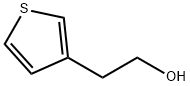
3-Thiopheneethanol [3-(2-hydroxyethyl)thiophene] was used in the synthesis of various ether and ester derivatives such as 3-(2-(benzyloxy)ethyl)thiophene, 3-[2-((triphenylmethyl)oxy)ethyl]thiophene, 3-[2-((trimethylsilyl)oxy)ethyl]thiophene, 3-[2-((dimethyl-tert-butylsilyl)oxy)ethyl]thiophene, 3-(2-acetoxyethyl)thiophene and 3-(2-(benzoyloxy)ethyl)thiophene.
Uses
3-Thiopheneethanol is used as a reagent in the synthesis of pH-responsive near-IR emitting conjugated polymer nanoparticles for cellular imaging and controlled-drug delivery. 3-Thiopheneethanol is also used as a reagent in the preparation of potent respiratory syncytial virus RNA polymerase inhibitors.
Synthesis
Step 2: Synthesis of 2-(thiophen-3-yl)ethanol
1. to LiAlH4 (4.56 g, 0.12 mol) was added tetrahydrofuran (200 mL) at 0 °C and the mixture was stirred.
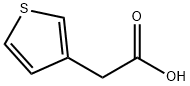
2. Slowly add THF solution of 2-(thiophen-3-yl)acetic acid (14.2 g, 0.1 mol dissolved in 100 mL of THF) dropwise to the above mixture, keeping the temperature at 0 °C.
3. after the dropwise addition was completed, the reaction mixture was continued to be stirred at 0 °C for 2 hours.
4. EtOAc (200 mL) was slowly added to the reaction mixture followed by water (5 mL) to quench the reaction.
5. The resulting suspension was filtered through diatomaceous earth and the filtrate was dried with anhydrous sodium sulfate.
6. The dried filtrate was concentrated to dryness to give 2-(thiophen-3-yl)ethanol (12.44 g, yield: 99%).
7. The product was characterized by 1H NMR (MeOD, 400 MHz): δ 5.92-5.87 (m, 1H), 5.69-5.66 (m, 1H), 5.57 (s, 1H), 2.90 (d, J=14.0 Hz, 1H), 2.38 (d, J=14 Hz, 1H), 1.55-1.42 (m, 2H).
References
[1] Patent: US2011/76291, 2011, A1. Location in patent: Page/Page column 148
[2] Synthesis, 2005, # 2, p. 267 - 271
[3] Synthesis (Germany), 2015, vol. 47, # 24, p. 3972 - 3982
[4] Molecular Crystals and Liquid Crystals Science and Technology, Section A: Molecular Crystals and Liquid Crystals, 1994, vol. 256, p. 439 - 448
[5] Organic Process Research and Development, 2015, vol. 19, # 11, p. 1568 - 1575