Description
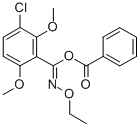
Benzoximate is an acaricide used to control all stages of spider mites on pome fruit, stone fruit, citrus fruit, vines and ornamentals. It was commercialized in Japan in 1971 but discontinued there in 1998 and is currently registered only in Italy, South Korea, South Africa and Switzerland.
Chemical Properties
Pure product is white crystal. m.p. 73℃, vapor pressure <1.33×10⁻²Pa (4.53×10⁻⁴Pa (25℃). solubility at 20℃: benzene 650g/L, dimethylformamide 1460g/L, xylene 710g/L (1296g/L), ethanol 70g/L (93g/L), hexane 8g/L, acetone 980g /L (1440g/L); almost insoluble in water. Stable to acid, easy to decompose in strong alkali medium, decomposition or isomerization at about 80℃.
Uses
Benzoximate is an acaricide that inhibits fruit tree red spider mite Panonychys ulmi (Koch)[1].
Production Methods
While detailed production steps are not widely published for benzoximate due to its obsolete status, its synthesis generally involves constructing a bridged diphenyl structure with functional groups that confer contact and stomach toxicity to mites. The molecule includes a chlorinated aromatic ring and ester functionalities, suggesting that its production likely involves electrophilic aromatic substitution, esterification, and condensation reactions to form the final active compound.
Mode of action
The mode of action of benzoximate is not known. Resistance has been reported in citrus red mite, European red mite and twospotted spider mite.
Toxicity evaluation
Benzoximate is relatively non-toxic to mammals and fish, but is moderately toxic to predatory mites.
References
[1] Kim YJ, et al. Multiple resistance and biochemical mechanisms of pyridaben resistance in Tetranychus urticae (Acari: Tetranychidae). J Econ Entomol. 2006 Jun;99(3):954-8. DOI:
10.1603/0022-0493-99.3.954
Pesticide Type
Acaricide; Miticide