Uses
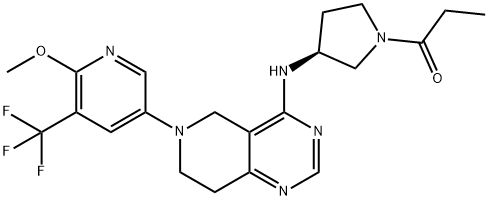
Leniolisib (CDZ173) is a potent and selective PI3Kδ inhibitor. Leniolisib has the potential for immunodeficiency disorders treatment.
Biological Activity
Leniolisib (CDZ 173) is a potent and selective PI3Kδ inhibitor with IC50s of 0.244, 0.424, 2.23 and 0.011 μM for PI3Kα, PI3Kβ, PI3Kγ and PI3Kδ, respectively.
Synthesis
The synthesis of leniolisib starts with compound 1 as shown in Scheme 1 (Hoegenauer et al., 2016; Hoegenauer et al., 2017).

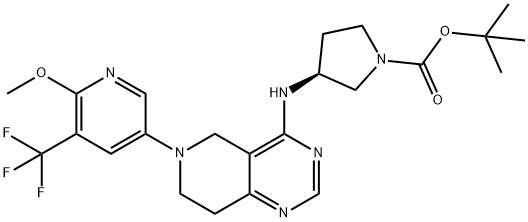
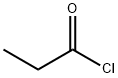
6-Benzyl-4-chloro-5,6,7,8-tetrahydro-pyrido[4,3-d]pyrimidine (compound 1) is coupled with (S)-tert-butyl 3-aminopyrrolidine-1-carboxylate (compound 2) in the presence of triethylamine at 120 °C for 42 h to give compound 3 a 93% yield. The benzyl group is deprotected with 20% palladium hydroxide on carbon and ammonium formate in methanol at 65 °C for 2 h to give compound 4 a 66% yield. Compound 4 is coupled with 5-bromo-2-methoxy-3-(trifluoromethyl)pyridine (compound 5) in the presence of sodium -tert-butoxide, tris(dibenzylideneacetone)dipalladium(0), 2-di-t-butylphosphino-2'-(N,N-dimethylamino)biphenyl in tert-butanol at 100 °C for 5 h to give compound 6 a 74% yield. Deprotection of the Boc group in DCM/TFA, followed by coupling with propionyl chloride in the presence of sodium bicarbonate in DCM at room temperature for 1 h gives the final compound 7 (leniolisib) a 76% yield.
in vivo
Oral leniolisib lead to a dose-dependent reduction in PI3K/AKT pathway activity and resolve the immune dysregulation with normalization of circulating transitional and nave B cells and reduction in PD-1+CD4+ and senescent CD57+CD8+ T cells. After 12 weeks of treatment, all patients show amelioration of lymphoproliferation with lymph node sizes and spleen volumes reduced by 39% (mean, range 26-57%) and 40% (mean, range: 13-65%), respectively[1].
target
| Target | Value |
PI3Kδ
(Cell-free assay) | 0.011 μM |
PI3Kα
(Cell-free assay) | 0.244 μM |
< td style="border-bottom: 1px dotted #ccc;padding: 5px;"> PI3Kβ
(Cell-free assay) 0.424 μM |
DNA-PK
() | 0.88 μM |
DNA-PK
(Cell-free assay) | 0.88 μM |
IC 50
PI3Kδ: 11 nM (IC
50); PI3Kα: 280 nM (IC
50); PI3Kβ: 480 nM (IC
50); PI3Kγ: 2.57 μM (IC
50); DNA-PK: 880 nM (IC
50)
References
[1] Rao V, et al. Effective 'Activated PI3Kd Syndrome' -targeted therapy with PI3Kd inhibitor leniolisib. The New England journal of medicine: NEJM. ISSN 0028-4793; 1533-4406 DOI:
10.1182/blood-2017-08-801191[2] Hoegenauer K, et al. Discovery of CDZ173 (Leniolisib), Representing a Structurally Novel Class of PI3K Delta-Selective Inhibitors. ACS Med Chem Lett. 2017 Aug 25;8(9):975-980. DOI:
10.1021/acsmedchemlett.7b00293