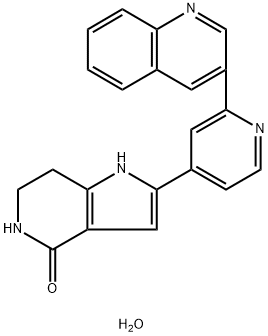
Description
MAP kinase-
activated protein kinase 2 (MAPKAP2, MK2) is a stress-
activated serine/threonine protein kinase that is phosphorylated by p38 MAP kinase and is involved in diverse cellular functions with a central role in inflammation. MK2 inhibitor III is a potent, cell-
permeable inhibitor of MK2 (IC
50 = 8.5 nM). It less potently blocks MK3 and MK5 (IC
50s = 210 and 81 nM, respectively) and is weak or inactive against several other kinases, including other p38 MAP kinase targets. MK2 inhibitor III prevents LPS-
induced synthesis of TNF-
α in human monocyte-
like U937 cells (IC
50 = 4.4 μM).
Uses
MAP kinase-activated protein kinase 2 (MAPKAP2, MK2) is a stress-activated serine/threonine protein kinase that is phosphorylated by p38 MAP kinase and is involved in diverse cellular functions with a central role in inflammation. MK2 inhibitor III is a potent, cell-permeable inhibitor of MK2 (IC50 = 8.5 nM). It less potently blocks MK3 and MK5 (IC50s = 210 and 81 nM, respectively) and is weak or inactive against several other kinases, including other p38 MAP kinase targets. MK2 inhibitor III prevents LPS-induced synthesis of TNF-α in human monocyte-like U937 cells (IC50 = 4.4 μM).[Cayman Chemical]
References
[1] XIAOHUA HUANG* Gerald W S Jr. Discovery and Hit-to-Lead Optimization of Non-ATP Competitive MK2 (MAPKAPK2) Inhibitors[J]. ACS Medicinal Chemistry Letters, 2011, 2 8: 632-637. DOI:
10.1021/ml200113y[2] XIAOZHE WANG. Phosphorylation of HSF1 by MAPK-activated protein kinase 2 on serine 121, inhibits transcriptional activity and promotes HSP90 binding.[J]. The Journal of Biological Chemistry, 2006, 281 2: 782-791. DOI:
10.1074/jbc.m505822200[3] O. WERZ. Arachidonic Acid Promotes Phosphorylation of 5-Lipoxygenase at Ser-271 by MAPK-activated Protein Kinase 2 (MK2)*[J]. The Journal of Biological Chemistry, 2002, 25 1: 14793-14800. DOI:
10.1074/jbc.m111945200[4] DAVID R. ANDERSON. Pyrrolopyridine Inhibitors of Mitogen-Activated Protein Kinase-Activated Protein Kinase 2 (MK-2)[J]. Journal of Medicinal Chemistry, 2007, 50 11: 2647-2654. DOI:
10.1021/jm0611004