Biological Activity
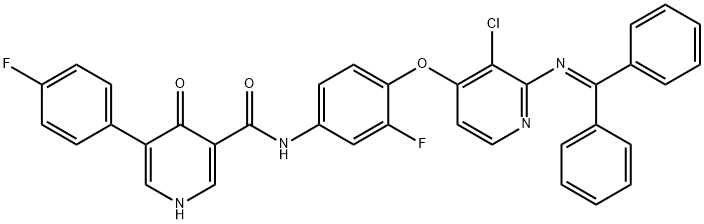
bms-794833 is a potent atp competitive, dual inhibitor of c-met and vegfr2 (ic50 = 1.7 nm and 15 nm, respectively). it also has inhibitory effect on ron, axl and flt3 (ic50 < 3 nm).c-met, also called met, is a membrane receptor that is essential for embryonic development and wound healing. vegfr are receptors for vascular endothelial growth factor and belong to receptor tyrosine kinases. it mediates in various cellular functions, including endothelial proliferation, migration, survival, tubular morphogenesis and sprouting. [1]bms794833 also inhibited gastric cancer cell line (gtl-16) that induced by c-met receptor, gtl-16, ic50 = 39 nm [1]. in human gastric tumor xenografts model, bm798433 exhibits > 50% tgi for at least one tumor doubling time without significant toxicity in 14 days. in u87 glioblastoma model, 25mg/kg of bms798433 exert complete tumor stasis. [1]
Synthesis
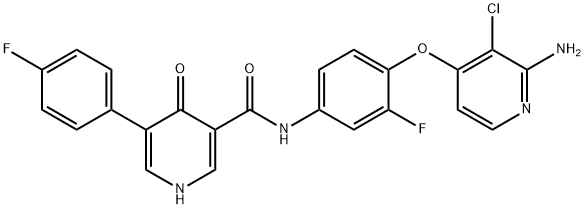
General procedure for the synthesis of N-(4-((2-amino-3-chloropyridin-4-yl)oxy)-3-fluorophenyl)-5-(4-fluorophenyl)-4-oxo-1,4-dihydropyridine-3-carboxamide from compound (CAS:1174047-03-0): at room temperature, N-(4-(3-chloro-2-(diphenylmethyleneamino)pyridin-4-yl oxy)-3-fluorophenyl)-5-(4-fluorophenyl)-4-oxo-1,4-dihydropyridine-3-carboxamide (410 mg, 0.65 mmol) solution in THF (10 mL) was slowly added to 2M HCl aqueous solution (0.81 mL, 1.62 mmol). The reaction mixture was stirred at room temperature for 1 hour and then concentrated under vacuum. The residue was cooled to room temperature and 5% aqueous cold hydrochloric acid solution (5 mL) was added. The precipitated solid was collected by filtration, washed sequentially with water and ether and finally dried under vacuum to give the target product (275 mg, 90% yield). The product was confirmed by 1H NMR (DMSO-d6) and mass spectrometry (ESI+): 1H NMR (DMSO-d6) δ 13.31 (s, 1H), 12.70 (br s, 1H), 8.63 (d, 1H, J = 1.30 Hz), 8.09 (d, 1H, J = 1.50 Hz), 8.02 (dd, 1H, J = 2.50, 13.10 Hz), 7.76 (d, 1H, J = 5.50 Hz), 7.71 (m, 2H), 7.44 (dd, 1H, J = 1.50, 8.80 Hz), 7.31 (t, 1H, J = 8.80 Hz), 7.27 (t, 2H, J = 8.80 Hz), 6.43 (br s, 2H), 5.96 (d, 1H, J = 5.60 Hz); MS (ESI+) m/z 469 (M + H)+.
References
[1] 4-pyridinone compounds and their use of cancer, borzilleri et al, united states patent application publication, pub no. : us 2012/0114643 a1, pub.date: may 10, 2012.


![3-Pyridinecarboxamide, N-[4-[[3-chloro-2-[(diphenylmethylene)amino]-4-pyridinyl]oxy]-3-fluorophenyl]-5-(4-fluorophenyl)-1,4-dihydro-4-oxo-](/CAS/20200611/GIF/1174047-03-0.gif)