Description
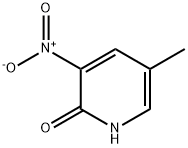
2-Hydroxy-5-methyl-3-nitropyridine (HMPN) is an organosynthetic compound that can be used as a feedstock for the synthesis of other compounds or as a biological inhibitor, such as in the preparation of 2-chloro-5-methyl-3-nitropyridine and transglutaminase 2 (tg2) inhibitors. It reacts with molybdenum and chloride. It is able to react with molybdenum and chloride, and it is able to increase the reaction yield and time. It is also used to explain its reactivity with xylene.
Chemical Properties
Powder or crystalline
Uses
2-Hydroxy-5-methyl-3-nitropyridine may be used in the preparation of 2-chloro-5-methyl-3-nitropyridine via chlorination, using thionyl chloride. It may also be used is preparing proteasome inhibitors containing 5-methylpyridin-2(1
H)-one moiety.
Synthesis
Example 3: Synthesis of 2-(1-vinylimino)-5-carbamoyl-3-nitropyridine (Compound III)
Reagents and conditions:
(i) HNO3/H2SO4, followed by NaNO2.
(ii) POCl3.
(iii) Na2Cr2O7; (iv) SOCl2
(iv) SOCl2, followed by NH4OH/THF.
(v) Aziridine.
Steps for the synthesis of compound 14:
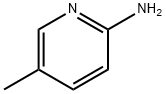
1. cool concentrated sulfuric acid (25 mL) in an ice bath, slowly add feedstock compound 13 (5 g, 0.0462 mol) and cool to 0 °C.
2. Slowly add 6 mL of a mixture of concentrated sulfuric acid (98%) and concentrated nitric acid (72%) in a volume ratio of 1:1 and keep the reaction temperature at 0-5 °C for 2 hours.
3. the reaction solution was poured into 100mL of ice water, 6g of sodium nitrite was added and stirring was continued in an ice bath for 4 hours.
4. The solid was precipitated, filtered and the filter cake was dried to give 4.4 g of compound 14 in 61.9% yield.
5. The melting point was determined to be 177-178 °C (water) (literature reports melting points of 178-180 °C) [J.O.C., 1944, 14, 328-332].
References
[1] Patent: EP2366691, 2011, A1. Location in patent: Page/Page column 8-9
[2] Bioorganic and Medicinal Chemistry, 2015, vol. 23, # 5, p. 985 - 995
[3] Bioorganic and Medicinal Chemistry, 2008, vol. 16, # 23, p. 9948 - 9956