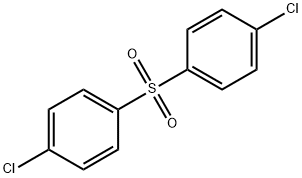
General Description
Crystals or off-white powder.
Reactivity Profile
4,4'-DICHLORODIPHENYL SULFONE(80-07-9) is incompatible with strong oxidizers.
Air & Water Reactions
Insoluble in water.
Fire Hazard
Flash point data for this chemical are not available; however, 4,4'-DICHLORODIPHENYL SULFONE is probably combustible.
Chemical Properties
off-white crystals or powder
Uses
4,4’Dichlorodiphenyl Sulfone is an impurity of Dapson (D193250), an antibacterial used in the treatment of dermatitis herpetiformis.
Application
4,4'-Dichlorodiphenyl sulfone (DCDPS) is an important chemical reagent. It participates in polymerization through nucleophilic substitution reactions and serves as a key monomer in the synthesis of high-temperature-resistant engineering plastics such as polysulfone (PSF) and polyarylethersulfone (PAES). Its primary applications include:
(1) DCDPS serves as a copolymer monomer for proton exchange membranes (PEMs) used in direct methanol fuel cells (DMFCs), replacing Nafion membranes to improve methanol barrier properties and thermal stability[1].
(2) DCDPS serves as a monomer for the engineering plastic PSF, used to prepare high-performance polymer membrane materials for applications in water treatment, gas separation, electronics, and electrical appliances[2].
(3) DCDPS is also used as an insecticide and as a reactive dye in the textile industry.
Health effects
4,4'-Dichlorodiphenyl sulfone (DCDPS) is not expected to be irritating to the eyes and skin and is not expected to be sensitizing. Accidentally swallowing DCDPS one time in a small amount is not likely to cause injury. However, swallowing DCDPS repeatedly over a long period of time, has been shown to cause effects on the liver in animals. DCDPS is not considered a carcinogen (cancer-causing). DCDPS does not have a toxic effect on fertility or a developing child.
Flammability and Explosibility
Nonflammable
Safety Profile
Mildly toxic by ingestion. When heated to decomposition it emitsvery toxic fumes of Cl- and SOx.
Synthesis
4,4'-Dichlorodiphenyl sulfone (DCDPS) is obtained by reacting dimethyl sulfate with sulfur trioxide at 10°C to 120°C, followed by further reaction of the resulting mixture with monochlorobenzene at 10°C to 120°C for 30 minutes. After the reaction is complete, the mixture is treated with an organic solvent or an organic solvent-water mixture at 20°C to 100°C for 30 minutes, cooled, and the precipitate is isolated to yield DCDPS with a yield of 80% and a purity of 99%. Further purification with monochlorobenzene yields DCDPS with a purity of ≥99.5%.
Environmental Fate
4,4'-Dichlorodiphenyl sulfone (DCDPS) is not sold to the general public. The chemical has properties indicating it may be a hazard to the environment. DCDPS is consumed during the formation of the polymer, which means that it is unlikely that there is any unreacted or free DCDPS in final consumer products. DCDPS is considered stable in water (will not degrade in water). DCDPS has been experimentally demonstrated to be not readily biodegradable in soil and sediment (activated sludge). This means it is not easily broken down by bacteria or enzymes in soil and sediment.
References
[1] Dae Sik Kim. (2005). Synthesis of sulfonated poly(imidoaryl ether sulfone) membranes for polymer electrolyte membrane fuel cells. Journal of Polymer Science Part A: Polymer Chemistry, 43 22, 5620–5631.
https://doi.org/10.1002/pola.21066[2] Kousuke Tsuchiya. (2015). Synthesis of poly(arylene ether sulfone): 18-Crown-6 catalyzed phase-transfer polycondensation of bisphenol A with 4,4′-dichlorodiphenyl sulfone. Polymer Journal, 47 5, 353–354.
https://doi.org/10.1038/pj.2015.9