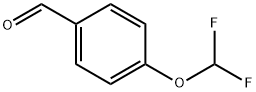
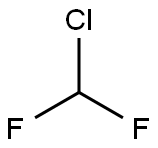
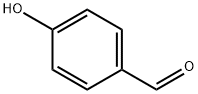
Example 1 Synthesis of 4-(difluoromethoxy)benzaldehyde: In a 1 L four-necked round-bottomed flask equipped with a thermometer, reflux condenser, mechanical stirrer, and gas introduction tube, 50 g (0.41 mol) of p-hydroxybenzaldehyde and 400 mL of isopropanol were added. After stirring the mixture for 20 minutes, 120 mL of a 120 mL aqueous solution containing 5 g of 18-crown-6 ether and 106.3 g (2.665 mol) of sodium hydroxide was slowly added dropwise. After the dropwise addition was completed, stirring was continued for 30 minutes and the mixture was subsequently heated to 65°C. Chlorodifluoromethane was slowly passed through the gas introduction tube over a period of 5-6 hours and the reaction process was monitored by thin layer chromatography (TLC). Upon completion of the reaction, the mixture was cooled to 15 °C and 400 mL of water was added to quench the reaction. The reaction mixture was extracted three times with ether (3 x 300 mL). The organic layers were combined, washed with water to pH=7 and dried over anhydrous magnesium sulfate. The ether was removed by rotary evaporation and the residue was distilled under reduced pressure to collect the 85-87 °C/10 mmHg fraction to give 4-(difluoromethoxy)benzaldehyde in 95% yield.1H-NMR (ppm) δ: 9.87 (1H, s, -CHO); 7.70 (2H, m, 2,6-ArH); 7.36 (1H, t, J2H-F = 68 Hz, - CHF2); 6.96 (2H, m, 3,5-ArH).