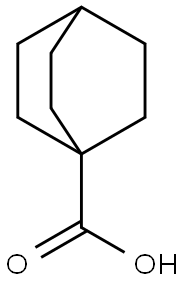
To a round-bottomed flask was added 4-(methoxycarbonyl)bicyclo[2.2.2]octane-1-carboxylic acid (1 g, 4.71 mmol), 2,2'-disulfonylbis(pyridine 1-oxide) (1.427 g, 5.65 mmol) and dichloromethane (50 mL). The flask was wrapped in aluminum foil to protect from light. The suspension was cooled to 0 °C and tributylphosphine (1.453 mL, 5.89 mmol) was added dropwise. The ice bath was removed and the reaction mixture continued to be stirred for 2 hours. The reaction system was again cooled to 0 °C and 2-methylpropane-2-thiol (4.7 mL, 41.7 mmol) was added. The reaction mixture was irradiated using a 300W tungsten lamp for 1.25 hours. The reaction was quenched by adding a suspension of calcium hypochlorite (10 g) in water (100 mL). The mixture was diluted with ether and stirred at 0°C for 5 min and then at room temperature for 20 min. Diatomaceous earth was added to assist in stratification and the mixture was filtered. The filtrate was transferred to a partition funnel and the organic layer was separated. The organic phase was washed with brine, dried over magnesium sulfate and concentrated. The residue was dissolved in a methanol/water (1:1, 100 mL) solution of potassium hydroxide (5 g) and stirred overnight at room temperature. The reaction solution was concentrated to remove most of the methanol, and the by-products were removed by extraction with ether (2×) (discarded). The aqueous phase was acidified with concentrated hydrochloric acid to pH acidic and a white precipitate was precipitated. The precipitate was collected by filtration to give 530 mg of product (66% yield).1H NMR (CDCl3) δ: 11.13 (br.s, 1H), 1.73-1.84 (m, 6H), 1.64-1.68 (m, 1H), 1.53-1.64 (m, 6H).


![BICYCLO[2.2.2]OCTANE-1,4-DICARBOXYLIC ACID HEMIMETHYL ESTER](/CAS/GIF/18720-35-9.gif)
![bicyclo[2.2.2]octane-1-carboxylic acid](/CAS/GIF/699-55-8.gif)