Definition
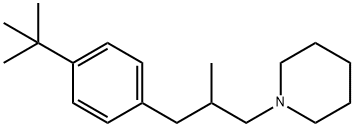
ChEBI: A member of the class of piperidines that is N-isobutylpiperidine in which a hydrogen of one of the methyl groups is replaced by a p-tert-butylphenyl group.
Uses
Agricultural fungicide.
Hazard
Moderately toxic by ingestion, inhalation,
and skin contact.
Description
fenpropidine, a piperidine derivative,
and spiroxamine, a dioxolanemethyleneamine derivative
introduced in 1996 , belong to the same group
of fungicides.
Chemical Properties
Pure phenyl rustidine is light yellow, viscous, odorless liquid. Boiling point:>250°C,70.2°C/1.1Pa.Distribution coefficient KowlgP(25°C,pH 7)=2.9,Henry's constant 10.7 Pa-m3/mol(25°C,calculated). Relative density 0.91(20℃). Solubility in water(g/m3,25℃):530(pH 7),6.2(pH 9);Freely soluble in acetone,ethanol,toluene,n-octanol,n-hexane and other organic solvents. Stable for at least 3 years in closed containers at room temperature, its aqueous solution is UV stable and not hydrolyzed. Strong base,pKa10.1, flash point 156℃.
Production Methods
Fenpropidin is commercially synthesised through a multi-step process involving alkylation and cyclization reactions. The synthesis begins with 1-(2-methyl-3-phenylpropyl)piperidine, which is dissolved in methylene chloride and treated with concentrated sulfuric acid under cooling to maintain an internal temperature around 10 DegC. After acidification, tert-butanol is added to the mixture, which is then allowed to react at room temperature for several hours. The reaction mixture is subsequently neutralized, extracted, and purified, typically via fractional distillation using a Goodloe silver column, to yield high-purity fenpropidin.
Mechanism of action
Systemic with curative and protective action. Inhibits sterol biosynthesis in membranes.
Metabolic pathway
Limited data are available in the open literature. Information presented in
this summary is abstracted from the data evaluation published by the
Pesticide Safety Directorate (PSD, 1993). Fenpropidin is stable to aqueous
hydrolysis and photodegradation. Hydroxylation of the piperidine ring is
the primary metabolic pathway in soil and wheat plants. Hydroxylation
and oxidation of one of the methyl groups of the tert-butyl moiety are
the major reactions in rats and lactating goats. The primary metabolic
pathways of fenpropidin are presented in Scheme 1.
Degradation
Fenpropidin (1)i s stable to hydrolytic degradation (50 °C)in the pH range
of 3-9 and when exposed to UV light in pH 5 buffer solution.