Uses
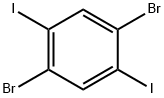
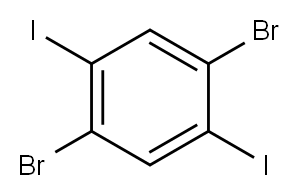
1,4-Dibromo-2,5-diiodobenzene is a useful synthetic intermediate in the synthesis of Benzo[1,2-b:4,5-b'']dithiophene (B200100); a reagent in the synthesis of high-crystalline medium-band-gap polymers used for organic photovoltaic cells. Benzo[1,2-b:4,5-b'']dithiophene is also a precursor in the preparation of benzodithiophene derivatives which are useful as hole injection material, hole transport material, or fluorescent material in organic electroluminescence devices.
Synthesis
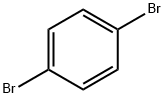
General procedure for the synthesis of 1,4-dibromo-2,5-diiodobenzene from 1,4-dibromobenzene: In a three-necked flask equipped with a 1-liter mechanical stirrer, 16.7 g (73.0 mmol) of periodic acid and 525 ml of sulfuric acid were added. After the periodate was completely dissolved, 36.4 g (219 mmol) of potassium iodide was added in batches. The reaction mixture was cooled to -30°C, followed by the slow addition of 34.5 g (146 mmol) of 1,4-dibromobenzene over 5 min. The resulting mixture was stirred continuously at -25°C for 36 hours. Upon completion of the reaction, the mixture was poured into 2 Kg of ice and the solid product was collected by filtration. The solid was dissolved in chloroform and the organic phase was washed sequentially with 5% aqueous sodium hydroxide and deionized water, then dried with anhydrous magnesium sulfate. After concentration under reduced pressure, the residue was recrystallized by chloroform to give 36.0 g of white crystals (50% yield).1H NMR (CDCl3, 21 °C): δ = 8.02 (s, 2H). The 1H NMR spectrum was consistent with the data reported in the literature for 1,4-dibromo-2,5-diiodobenzene, confirming the successful synthesis of the target product.
References
[1] Organic Letters, 2009, vol. 11, # 20, p. 4656 - 4659
[2] Journal of Organic Chemistry, 2003, vol. 68, # 23, p. 8750 - 8766
[3] Journal of the American Chemical Society, 2011, vol. 133, # 10, p. 3284 - 3287
[4] Patent: CN106543216, 2017, A. Location in patent: Paragraph 0023; 0024; 0036; 0043
[5] Patent: CN108117563, 2018, A. Location in patent: Paragraph 0028; 0029; 0030