Production Methods
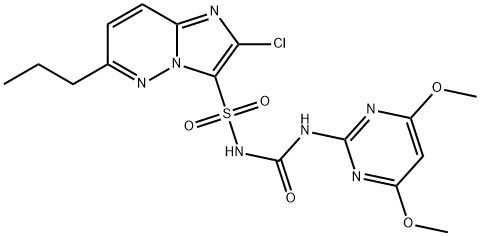
The commercial production of propyrisulfuron involves the synthesis of a complex urea derivative featuring a sulfonylated imidazo[1,2-b]pyridazine ring and a dimethoxypyrimidine moiety. The process typically includes multiple steps such as chlorination, sulfonylation, and urea formation, requiring precise control of reaction conditions to ensure high purity and yield.
Agricultural Uses
Propyrisulfuron is a sulfonylurea introduced in 2011 by Sumitomo as solo product under the trade name ZETA-ONE® and in combination with pyraclonil as MEGAZETA®. The structure is related to the imazosulfuron class. The compound was introduced in 2011 and is considered to be a newgeneration sulfonylurea for the control of annual and perennial broadleaf weeds and sedges, especially against acetolactate synthase (ALS)-resistant weed biotypes. At rates of 70 g a.i. ha−1, propyrisulfuron controls C. serotinus, C. difformis, E. triandra, E. congesta, E. kuroguwai, L. annua, L. procumbens, M. vaginalis, R. indica, S. pygmaea, S. trifolia, and S. juncoides. At a higher rate of 90 g a.i. ha−1, which is the application rate registered in Japan, it gives total weed control, including Echinochloa spp.