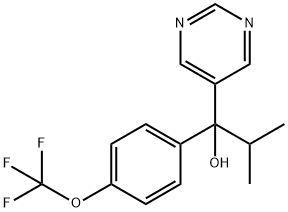
Chemical Properties
White to pale yellow or buff crystalline solid.
Slight aromatic odor.
Uses
Growth retardant for grasses.
Potential Exposure
Pyrimidine plant growth regulator
Used on turf and ornamental trees which reduces internode
and leaf elongation in cool and warm seasons. A turf grass
growth deterrent.
First aid
If this chemical gets into the eyes, remove any
contact lenses at once and irrigate immediately for at least
15 minutes, occasionally lifting upper and lower lids. Seek
medical attention immediately. If this chemical contacts
the skin, remove contaminated clothing and wash immedi ately with soap and water. Seek medical attention immedi ately. If this chemical has been inhaled, remove from
exposure, begin rescue breathing (using universal precau tions) if breathing has stopped, and CPR if heart action
has stopped. Transfer promptly to a medical facility.
When this chemical has been swallowed, get medical
attention. Give large quantities of water and induce vomit ing. Do not make an unconscious person vomit. Do not
induce vomiting when formulations containing petroleum
solvents are ingested
Shipping
UN3077 Environmentally hazardous substances,
solid, n.o.s., Hazard class: 9; Labels: 9-Miscellaneous haz ardous material, Technical Name Required.
Incompatibilities
Decomposes in temperatures above
200℃. May react with strong oxidizers such as chlorates,
peroxides, nitrates, etc.
Description
Flurprimidol is a plant growth regulator used to retard growth in a wide range of mono- and dicotyledonous weed species. It is moderately soluble in water, has a low volatility but there is some risk of drift under certain conditions. Generally, it is not persistent in soils or water-sediment systems. Regarding human health there is some concern that it may be a reproduction/developmental toxin. Oral mammalian toxicity is moderate. Toxicity to biodiversity is low to moderate.
Waste Disposal
Must be disposed properly by
following package label directions or by contacting your
local or federal environmental control agency, or by con tacting your regional EPA office. If this material cannot be
disposed of according to label instructions, it may be dis solved or mixed with a combustible solvent and burned in
a chemical incinerator equipped with an afterburner and
scrubber. In accordance with 40CFR165, follow recommen dations for the disposal of pesticides and pesticide contain ers. Noncombustible containers should be crushed and
buried under more than 40 cm of soil.
Definition
ChEBI: Flurprimidol is an alkylbenzene.
Production Methods
Flurprimidol is commercially produced through a streamlined synthesis of 5-substituted pyrimidines, optimised for efficiency and reduced environmental impact. Traditionally, this process required cryogenic conditions and extended reaction times. However, an improved commercial method has been developed that bypasses the need for low temperatures and significantly shortens the synthesis duration; from four days to just one. This modern approach involves the condensation of appropriate aldehydes and amidines to form the pyrimidine ring, followed by selective substitution with a fluorinated phenyl group and an alcohol moiety.
Mechanism of action
Absorbed by leaves and roots. Gibberellin biosynthesis inhibitor.
Pesticide Type
Plant Growth Regulator; Herbicide