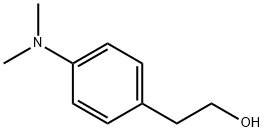
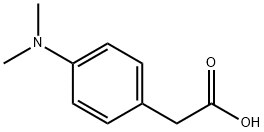
General procedure for the synthesis of 2-(4-(dimethylamino)phenyl)ethanol from 4-(dimethylamino)phenylacetic acid: as shown in Scheme 5, the used bromide synthesizers (41a-41c) were first converted to the corresponding alcohols by a reduction reaction, followed by bromination using PPh3/CBr4 (for 41a) or PPh3/Br2 (for 41b and 41c). This was done as follows: to a flame-dried, three-necked, 100 mL round-bottomed flask equipped with a condenser and argon line was added the appropriate carboxylic acid (10 mmol) dissolved in anhydrous THF (25 mL). After cooling the mixture to 0 °C, 1 M BH3*THF (20 mmol) was added dropwise to the stirring mixture, followed by keeping the reaction at 0 °C for 5 hours. After completion of the reaction, the reaction mixture was diluted with cold water, washed with saturated NaHCO3 solution and extracted with ethyl acetate (3 x 25 mL). The organic layers were combined, washed with brine (1 x 25 mL), dried over MgSO4, filtered, and concentrated under reduced pressure. The residue was purified by rapid chromatography on silica gel using 25% ethyl acetate-hexane as eluent to afford the target product, p-(N,N-dimethylamino)phenylethanol (40a). The yield was 90%; melting point was 56-57°C; 1H NMR (CDCl3) data: δ 2.77 (t, 2H, J = 6.6 Hz), 2.92 (s, 6H, NMe2), 3.80 (t, 2H, J = 6.5 Hz), 6.72 (d, 2H, J = 8.53 Hz), 7.10 (d, 2H, J = 8.51 Hz); 13C NMR (CDCl3) data: δ 38.21, 40.93 (NMe2), 64.01, 113.20 (2C, Ar), 126.43, 129.72 (2C, Ar), 149.51; IR (pure) data: 3284, 2855, 1617, 1527, 1352, 1049, 1021, 804; HRMS (ESI) m/z: C10H15NO [M + H]+ calculated value 166.1232, measured value 166.1225 [M + H]+.