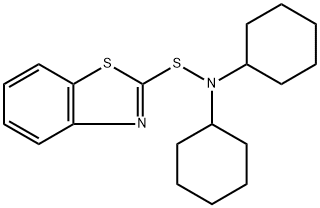
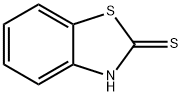
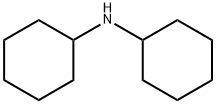
(1) Preparation of M-Na salt solution: mix 400g 2-mercaptobenzothiazole (MBT) with 360g 32wt% sodium hydroxide (NaOH) solution, stirring at 50 ℃ for 2 hours, to get the M-Na salt solution; Preparation of dicyclohexylamine hydrochloride solution: mix 567g of dicyclohexylamine with 376g of 31wt% industrial hydrochloric acid, add 567g of water, stirring at 35 ℃. The solution of dicyclohexylamine hydrochloride was obtained. (2) M-Na salt solution (flow rate of 69 mL/min), dicyclohexylamine hydrochloride solution (flow rate of 136 mL/min), toluene (flow rate of 130 mL/min) and sodium hypochlorite solution with 17% effective chlorine (flow rate of 49 mL/min) were continuously pumped into a microchannel reactor to carry out oxidation reaction. The reaction conditions were: residence time of 2 s, reaction temperature of 30°C, and four microchannel reactors in series were used, each with a volume of 3 mL and a total volume of 12.8 mL.(3) The reactor effluent material was collected, stirred and cooled to 5°C for crystallization. The crude product was washed sequentially twice each with 200 mL of isopropanol and 200 mL of water to obtain S-(benzo[d]thiazol-2-yl)-N,N-dicyclohexylmercaptoamine (DCBS) wet product. After drying, DCBS was obtained as a finished product with 96.2% yield (based on MBT content), 99.2 wt% purity, and a light yellow powder appearance. After recovery of isopropanol from continuous distillation effluent, the residual COD was 5900 ppm.