Uses
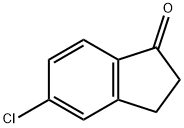
5-Chloro-1-indanone is the important intermediate of du pont company's new varieties of pesticides indoxacarb (popular name: indoxacarb), is also a kind of important medicine intermediate simultaneously.
5-Chloro-1-indanone is a 5-halo-1-indanone. It participates in the Irie′s synthesis of substituted pyridines. 5-Chloro-1-indanone has a stable triclinic crystal structure and has intermolecular forces of C-H...O, C-H...Π, CO...Cl and Π...Π types.
5-Chloro-1-indanone may be used as starting reagent for the preparation of 5-chloro-2-methoxycarbonyl-1-indanone. It may be used for the preparation of important biomedical compounds such as anticonvulsants, anticholinergics and diarylsulfonylureas, having potential activity against solid tumors.
Synthesis
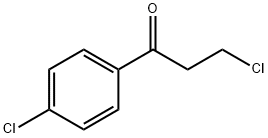
General procedure for the synthesis of 5-chloro-1-indanone from 3,4'-dichloropropiophenone: In an experimental setup equipped with a thermometer, a 500 mL four-necked flask, a stirrer, and a condensing device, 50 g of Et3NHCl-1.8AlCl3 ionic liquid (molar ratio 1.8) and 50 g of n-octane were added, and the temperature was raised to 70-80 °C. A solution consisting of 100 g of 3-chloro-1-(4-chlorophenyl)-1 -acetone and 100 g of n-octane was slowly added dropwise, followed by raising the temperature to 110-120 °C, and the reaction was kept at this temperature for 3-4 hours. The hydrogen chloride gas generated during the reaction was discharged through the top of the condenser tube and introduced into the suction tower for absorption. The reaction process was monitored by chromatography until 3-chloro-1-(4-chlorophenyl)-1-propanone was fully reacted. Upon completion of the reaction, the reaction mixture was transferred to a 1000 mL jacketed hydrolysis kettle and hydrolyzed by slowly adding 100 g of water under stirring. During the hydrolysis, the temperature was kept between 90-95 °C by circulating water cooling. Upon completion of hydrolysis, the stirring was stopped and the mixture was transferred to a separatory funnel and left to stratify. The separated n-octane phase enters the decolorization tank for conventional decolorization, and then the decolorized material is transferred to the crystallization kettle and cooled to 0-30°C for crystallization. The crystallization product was centrifuged and dried to obtain 72 g of finished 5-chloro-1-indanone product with a melting point of 92.6-93.5 °C and a yield of 72%.
References
[1] Patent: CN106588612, 2017, A. Location in patent: Paragraph 0018; 0019
[2] Asian Journal of Chemistry, 2012, vol. 24, # 3, p. 1413 - 1414
[3] Bulletin de la Societe Chimique de France, 1973, p. 3096 - 3099
[4] Journal of Materials Chemistry, 2012, vol. 22, # 10, p. 4483 - 4490
[5] Chemical Communications, 2016, vol. 52, # 56, p. 8757 - 8760