Production Methods
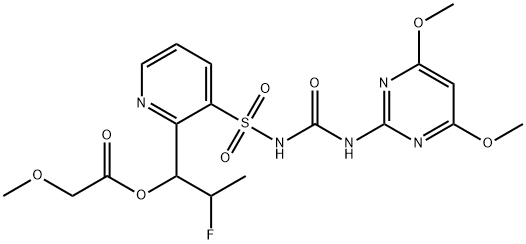
Flucetosulfuron is commercially produced through a multi-step synthesis involving sulfonylurea chemistry, starting with the preparation of key heterocyclic intermediates such as 4,6-dimethoxypyrimidine and substituted pyridine derivatives. These intermediates undergo sequential reactions including carbamoylation, sulfonylation, and esterification to form the final active compound. The process is carefully controlled to ensure the correct stereoisomeric ratio and high purity, as flucetosulfuron is a mixture of isomeric sulfonylureas.
Agricultural Uses
Details of flucetosulfuron (LGC-42153) were presented at the BCPC Conference in 2003 by the research group from LG Life Sciences Ltd. and KRICT and was commercialized in 2004. It can be used for the control of broadleaf weeds, some grass weeds, and also sedges in rice and cereal crops. In rice, flucetosulfuron provides excellent control of E. crus‐galli, which is usually not controlled by other commercial rice sulfonylurea products. In addition, the following weeds are controlled at an application rate of 10-20 g a.i. ha−1: Alisma spp., A. coccinea, C. difformis, Fimbristylis spp., Lindernia spp., M. vaginalis, Rorippa silvestri, R. indica, S. juncoides, S. mucronatus, and S. maritimus. At a higher rate of 20-30 g a.i. ha−1, a greater than 90% control of Aeschynomene indica, B. umbellatus, Eleocharis kuroguwai, S. pygmaea, S. trifolia, and Sparganium erectum is achieved by flucetosulfuron, with a high crop safety margin when applied to soil or foliage in direct‐seeded or transplanted rice.
In cereal crops, flucetosulfuron at a rate of 20-30 g a.i. ha−1 shows excellent activity against G. aparine and other broadleaf weeds, such as C. bursa‐pastoris, G. tetrahit, L. purpureum, Matricaria spp., M. arvensis, P. rhoeas, Raphanus raphanistrum, S. vulgaris, S. arvensis, S. media, and T. arvense while being safe to use in wheat and barley at up to three times the recommended application rate.
Mechanism of action
Broad-spectrum, absorbed by roots, stem and leaves, ALS inhibitor