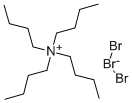
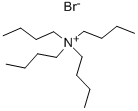
General procedure for the synthesis of tetrabutylammonium tribromide from tetrabutylammonium bromide: A sample of molybdic acid monohydrate (H2MoO4) was taken. H2O (0.16 mmol, 0.029 g) in a 250 mL glass beaker and 30% hydrogen peroxide (H2O2, 15.52 mmol, 1.76 mL) was added to it. The mixture was stirred at room temperature for 30 min. The slightly cloudy solution was filtered through Whatman No. 1 filter paper on a glass funnel. The clarified filtrate was collected in a 250 mL glass beaker and kept in an ice water bath. Tetrabutylammonium bromide (TBAB, 15.51 mmol, 5 g) and potassium bromide (KBr, 31.01 mmol, 3.69 g) dissolved in 0.3 M H2SO4 (15.52 mmol, 51.77 mL) were slowly added to the solution under continuous stirring, resulting in the formation of a yellow precipitate. The mixture was continued to be stirred in an ice-water bath for 1 h and then left to stand in an ice-water bath for 2 h to give an orange-yellow compound of tetrabutylammonium tribromide (TBATB). The compound was separated by filtration using Whatman No.1 filter paper under suction. It was dried in melted CaCl2 and recrystallized from acetonitrile. The yield was 7.23 g (96.7%), melting point: 76-77°C. The chemical analysis, IR and conductance of the compound were in good agreement with the data reported in the literature. Analytical data: compound correctly analyzed C16H36NBr3: Calculated values C, 39.86; H, 7.52; N, 2.90; Br, 49.71%. Measured values C, 39.41; H, 8.28; N, 2.78; Br, 49.53%.