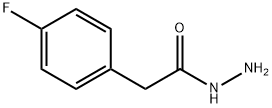
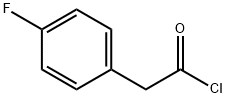
The general procedure for the synthesis of 2-(4-fluorophenyl)acetylhydrazine from 4-fluorophenylacetyl chloride was as follows: a solution of hydrazine (4.5 M, 144 mmol) in dichloromethane (50 mL) was added slowly and dropwise to a solution of (4-fluorophenyl)acetyl chloride (1.0 g, 5.8 mmol) in dichloromethane at 0 °C. The reaction mixture was stirred at 0 °C for 40 min. Subsequently, the reaction was terminated by addition of water. The organic and aqueous layers were separated and the aqueous layer was extracted with dichloromethane. All organic phases were combined and dried over anhydrous sodium sulfate. The desiccant was removed by filtration and the filtrate was concentrated under reduced pressure and purified by fast column chromatography (elution gradient: 5% methanol-dichloromethane) to afford 2-(4-fluorophenyl)acetohydrazide (673 mg, 69% yield) as a white solid. The product was characterized by 1H NMR (DMSO-D6): δ 9.18 (broad peak, 1H), 7.26 (dd, J = 8.4, 5.7 Hz, 2H), 7.09 (t, J = 8.4 Hz, 2H), 4.21 (broad peak, 2H), 3.31 (s, 2H); mass spectrum (MS) showed m/z 169 ([M + H]+).