Synthesis
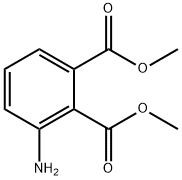
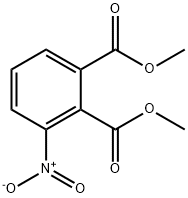
The general procedure for the synthesis of dimethyl 3-amino-phthalate from methyl 3-nitrophthalate was as follows: first, methyl 3-nitrophthalate was converted to the corresponding chloride by a chlorination reaction, followed by esterification to obtain dimethyl 3-nitrophthalate (100% yield). Next, the nitro group was reduced to an amino group by catalytic hydrogenation to obtain dimethyl 3-amino-phthalate (100% yield). Subsequently, diazotization of the amino group was followed by iodination to obtain dimethyl 3-iodophthalate (about 91% yield). Then, a saponification reaction was carried out on dimethyl 3-iodophthalate, followed by acidification to obtain 3-iodophthalic acid (yield about 93%). Finally, 3-iodophthalic acid was oxidized and reacted in the presence of KBrO3 and 0.73 M H2SO4 at 55-60 °C for 12 h to obtain water-soluble MIBX.Upon completion of the reaction, purification by evaporation, cooled milling and filtration yielded white solid MIBX (~70% yield, melting point 258-260 °C). The conversion of the process is nearly quantitative and can be monitored by 1H NMR spectroscopy.The physical properties of MIBX include IR (KBr) showing characteristic absorption peaks; 1H NMR (D2O, 300 MHz) and 13C NMR (D2O, 75 MHz) showing specific chemical shifts.
References
[1] Journal of Heterocyclic Chemistry, 1989, vol. 26, # 6, p. 1885 - 1886
[2] Tetrahedron Letters, 2002, vol. 43, # 4, p. 569 - 572
[3] Patent: US2004/30187, 2004, A1. Location in patent: Page 2; Sheet 1
[4] RSC Advances, 2015, vol. 5, # 60, p. 48861 - 48867
[5] Bioorganic and Medicinal Chemistry Letters, 2008, vol. 18, # 1, p. 285 - 288