Uses
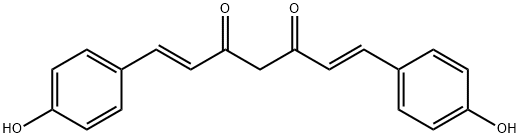
Bisdemethoxycurcumin is one of the three major forms of curcuminoids found in the rhizomes of turmeric. Bisdemethoxycurcumin displays antioxidant, anti-inflammatory as well as chemotherapeutic activit
y. Bisdemethoxycurcumin acts as an inhibitor of human pancreatic α-amylase, a target for type-2 diabetes .
Definition
ChEBI: Bisdemethoxycurcumin is a beta-diketone that is methane in which two of the hydrogens are substituted by 4-hydroxycinnamoyl groups. It has a role as a metabolite and an EC 3.2.1.1 (alpha-amylase) inhibitor. It is a beta-diketone, a polyphenol, an enone and a diarylheptanoid. It is functionally related to a 4-coumaric acid.
Biochem/physiol Actions
Bisdemethoxycurcumin (BDMC) is a derivative or curcumin, and represents one of the major active components of curcumin products isolated from Curcumae sp. BDMC shares similar anti-inflammatory properties with demethoxycurcumin. It inhibits LPS-induced nitric oxide (NO) production and expression of iNOS and COX2 in RAW264.7 cells by blocking NF-kB activation. BDMC also displays unique properties in that it enhances Abeta clearance by upregulating expression MGAT3 and TLR genes. BDMC potently inhibits AKR1B10.
Synthesis
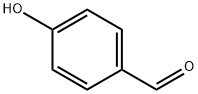
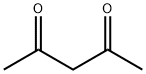
GENERAL METHOD: Acetylacetone (10 mmol) was dissolved in ethyl acetate (30 mL), boronic anhydride (5.0 mmol) was added, followed by 4-hydroxybenzaldehyde (20 mmol) and tributyl borate (40 mmol). The reaction mixture was stirred at 50 °C for 10 min. Then, a solution of n-butylamine (5.0 mmol) in ethyl acetate (5 mL) was slowly added dropwise at 50 °C. After the dropwise addition, the reaction temperature was raised to 80 °C and stirring was continued for 4 hours. After completion of the reaction, the reaction was quenched by the addition of 1N hydrochloric acid (30 mL) and stirring was continued for 40 minutes. The organic layer was separated, washed with water and dried over anhydrous sodium sulfate. The solvent was evaporated under reduced pressure and the residue was recrystallized from methanol to give the target product bisdemethoxycurcumin (1a or 1b) as a yellow solid.
References
[1] Molecules, 2011, vol. 16, # 2, p. 1888 - 1900
[2] Molecules, 2014, vol. 19, # 10, p. 16349 - 16372
[3] Archiv der Pharmazie, 2004, vol. 337, # 1, p. 42 - 54
[4] Food Chemistry, 2010, vol. 119, # 4, p. 1435 - 1442
[5] Bioorganic and Medicinal Chemistry, 2005, vol. 13, # 23, p. 6374 - 6380