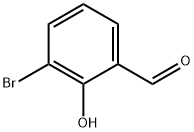
The general procedure for the synthesis of 3-bromo-2-hydroxybenzaldehyde using 7-bromo-2-methylbenzofuran as starting material was as follows: first, a stirred solution of some of the B compounds (1.94 g, 9.19 mmol) in dichloromethane (100 mL) was cooled to -78 °C through a calcium chloride drying tube, and then the 3% O3/O2 gas mixture was passed through until the solution took on a persistent blue color (ca. 35 min). Subsequently, the solution was purged with nitrogen, dimethyl sulfide (5 mL) was added, and the reaction mixture was slowly warmed to room temperature. After 4 hours of reaction, the solvent was evaporated and the residue was redissolved. Next, water (8 mL) and potassium carbonate (1.1 g, 80 mmol) were added to methanol (8 mL), and the mixture was heated to 55 °C for 1 h under argon protection. Upon completion of the reaction, the mixture was cooled, neutralized to pH 7 with 1 M bisulfate solution, and then extracted twice with dichloromethane. The organic phases were combined, dried with magnesium sulfate and the solvent was evaporated. Finally, purification by fast chromatography afforded 3-bromo-2-hydroxybenzaldehyde as a light yellow crystalline solid in a yield of 1.47 g (80% yield).LC/MS analysis showed that the molecular ion peak of the target compound [(M+H)+ = 201] was in agreement with expectations.