Synthesis
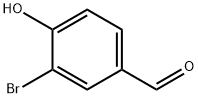
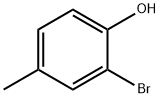
General procedure for the synthesis of 3-bromo-4-hydroxybenzaldehyde from 2-bromo-4-methylphenol: A mixture of the substrate 2-bromo-4-methylphenol (1 mmol), cobalt salt (n1 mol%), and NaOH (n2 eq.) in ethylene glycol (5 mL) was stirred with oxygen (1 atm) and bubbled for 8 hr at 80 °C. Upon completion of the reaction, hydrochloric acid (10 mL, 2%) and methyl tert-butyl ether (MTBE, 10 mL) were added sequentially to the reaction mixture. The organic layer was separated and the aqueous phase was further extracted with MTBE (10 mL x 2). All organic phases were combined and concentrated by drying with anhydrous sodium sulfate to give the residue. The residue was purified by silica gel column chromatography (eluent: petroleum ether/ethyl acetate, 10/1) to afford the target product 3-bromo-4-hydroxybenzaldehyde.
References
[1] Tetrahedron Letters, 2014, vol. 55, # 8, p. 1406 - 1411
[2] Green Chemistry, 2014, vol. 16, # 5, p. 2807 - 2814
[3] Green Chemistry, 2014, vol. 16, # 3, p. 1248 - 1254
[4] Research on Chemical Intermediates, 2015, vol. 41, # 6, p. 3855 - 3863
[5] Journal of Molecular Catalysis A: Chemical, 2016, vol. 420, p. 45 - 49