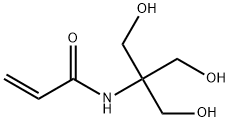
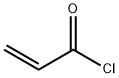
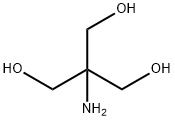
N-Acryloyl(tris(hydroxymethyl)aminomethane was synthesized from acryloyl chloride and tris(hydroxymethyl)aminomethane according to the method reported by Pucci et al. (Eur. Polym. J. 1991, 27, 1101). The procedure was as follows: to a stirred 3N potassium hydroxide methanol solution of tris(hydroxymethyl)aminomethane (3.00 g, 24.8 mmol), acryloyl chloride (3.60 mL, 44.6 mmol) was added slowly and dropwise at 0 °C, keeping the pH of the reaction system between 8 and 8. The reaction mixture was continued to be stirred at 0 °C for 3 h. The reaction was then naturally warmed to room temperature and continued for 4 h. The reaction was carried out at 0 °C. After completion of the reaction, the mixture was filtered and the filtrate was evaporated to dryness under vacuum. The resulting solid was purified by recrystallization from methanol to afford the target compound, N-acryloyl(trimethylol)aminomethane (3.78 g, 87%), as a white powder with a melting point of 205 °C. The product was purified by recrystallization from methanol. The product was characterized by the following data: IR (NaCl, cm^-1): 3420 (br, s), 1653 (s), 1560 (m), 1540 (m), 1018 (m); 1H NMR (300 MHz, DMSO-d6): δ 3.56 (d, 6H, J = 5.7 Hz, CH2), 4.76 (t, 3H, J = 5.7 Hz, OH), 5.54 (dd, 1H, J = 2.4, 9.9 Hz, Ha), 6.02 (dd, 1H, J = 2.4, 17.1 Hz, Hb), 6.37 (dd, 1H, J = 9.9, 17.1 Hz, Hc), 7.42 (s, 1H, NH).