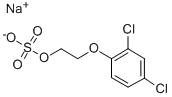
Chemical Properties
Crystalline solid. Soluble in
water.
Uses
Preemergence herbicide.
General Description
Colorless to white crystalline, odorless solid. Mp: 245°C (with decomposition). Manufacture discontinued in 1994 by Rhone-Poulenc Ag Co.
Hazard
Gastrointestinal irritant. Questionable car-
cinogen.
Potential Exposure
Used as corrosion inhibitor, pharma-
ceutical intermediate and emulsifier. A potential danger
to those involved in manufacture, formulation and applica-
tion of this herbicide as well as citizens in the area of
application.
First aid
If this chemical gets into the eyes, remove any
contact lenses at once and irrigate immediately for at least
15 minutes, occasionally lifting upper and lower lids. Seek
medical attention immediately. If this chemical contacts the
skin, remove contaminated clothing and wash immediately
with soap and water. Seek medical attention immediately.
If this chemical has been inhaled, remove from exposure,
begin rescue breathing (using universal precautions, includ-
ing resuscitation mask) if breathing has stopped and CPR if
heart action has stopped. Transfer promptly to a medical
facility. When this chemical has been swallowed, get medi-
cal attention. Give large quantities of water and induce
vomiting. Do not make an unconscious person vomit.
Shipping
UN3345 Phenoxyacetic acid derivative pesticide,
solid, toxic, Hazard Class: 6.1; Labels: 6.1-Poisonous
materials.
Incompatibilities
Incompatible with oxidizers (chlorates,
nitrates, peroxides, permanganates, perchlorates, chlorine,
bromine, fluorine, etc.); contact may cause fires or explo-
sions. Keep away from alkaline materials, strong bases,
strong acids, oxoacids, and epoxides.
Description
Sesone or Crag? pesticide is a colorless, odorless, crystalline solid. It is a noncombustible solid, but commercial products may be formulated using flammable864 2,4-DES-sodiumorganic solvents, which can change the physical propertiesshown here. Molecular weight = 309.13; Freezing/Meltingpoint = 245℃ (decomposes); Vapor pressure = 0.1 mmHg.Hazard Identification (based on NFPA-704 M RatingSystem): Health 3, Flammability 0, Reactivity 0. Soluble inwater; solubility = 26% at 25℃.
Waste Disposal
Sesone is hydrolyzed by
alkali to NaHSO4 and apparently dichlorophenoxyethanol.
In accordance with 40CFR165, follow recommendations
for the disposal of pesticides and pesticide containers. Must
be disposed properly by following package label directions
or by contacting your local or federal environmental control
agency, or by contacting your regional EPA office.
Production Methods
Commercial manufacture of disul was historically tied to its role as a precursor in the synthesis of the herbicide 2,4 D. Industrial production involved reacting 2,4 dichlorophenoxyethanol with sulfuric acid to form the corresponding hydrogen sulphate ester, yielding disul as a solid intermediate suitable for formulation or further conversion. To produce disul sodium, manufacturers neutralised this hydrogen sulphate ester with sodium hydroxide, generating the water soluble sodium salt
Mechanism of action
Not itself phytotoxic but is rapidly converted to 2,4-D which is synthetic auxin
storage
Color Code—Blue: Health Hazard/Poison: Storein a secure poison location. Prior to working with thischemical you should be trained on its proper handling andstorage. Store in tightly closed containers in a cool, wellventilated area away from oxidizers and acids. Where possible, automatically pump liquid from drums or other storagecontainers to process containers.