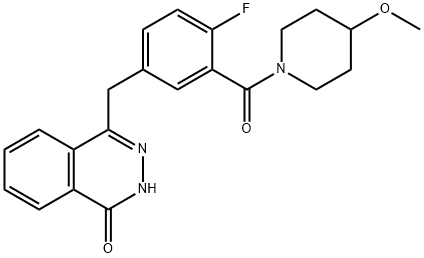
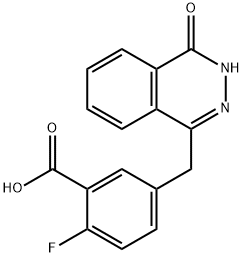
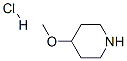
Example 1; 1-(3-dimethylaminopropyl)-3-ethylcarbodiimide hydrochloride (231 g, 1.206 mol) was added to a solution of dichloromethane (4.7 g, 0.251 mol) containing 4-methoxypiperidine hydrochloride (183 g, 1.206 mol), 5-[(3,4-dihydro-4-oxo-1-phthalazinyl)methyl]-2-fluorobenzoic acid (300 g, 1.005 mol), and 4-dimethylamino pyridine (30.7 g, 0.251 mol) in a solution of dichloromethane (4 L) was reacted at 23 °C. The resulting suspension was stirred at room temperature overnight. The reaction mixture was washed sequentially with 2 M hydrochloric acid (5 L) and 50% saturated sodium carbonate solution (3 L), followed by drying with anhydrous magnesium sulfate, filtration and concentration in vacuo to give the crude product. The crude product was slurried in ethyl acetate (750 mL) for 5 days, filtered and dried at 45 °C for 5 h to afford 4-[4-fluoro-3-[(4-methoxypiperidin-1-yl)carbonyl]benzyl]phthalazin-1(2H)-one (Compound 1) (290 g, 72.9% yield).1H NMR (400.132 MHz, DMSO) δ 1.26-1.35 ( 1H, m), 1.40-1.49 (1H, m), 1.69-1.73 (1H, m), 1.84-1.89 (1H, m), 2.99-3.07 (1H, m), 3.25 (3H, s), 3.27-3.34 (2H, m), 3.39-3.44 (1H, m), 3.86-3.95 (1H, m), 4.33 (2H, s). 4.33 (2H, s), 7.19-7.24 (1H, m), 7.33-7.35 (1H, m), 7.39-7.43 (1H, m), 7.81-7.91 (2H, m), 7.97 (1H, d), 8.27 (1H, d), 12.57 (1H, s); m/z (ES+) (M + H)+ = 396.31 ; HPLC tR = 1.90 min. Figure 1 illustrates the powder XRD pattern of the product showing it in crystalline form. Figure 2 illustrates the DSC analysis of the product.