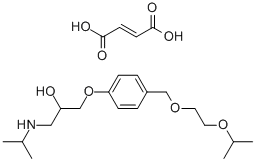
Description
Bisoprolol fumarate is a β1-selective adrenergic
blocker useful in the treatment of essential hypertension.
Chemical Properties
White Solid
Originator
E. Merck (W. Germany)
Uses
A selective a-adrenergic blocker. Used as an antihypertensive
Uses
A selective α-adrenergic blocker. Used as an antihypertensive.
Uses
A selective β-adrenergic blocker. Used as an antihypertensive.
Uses
Labeled Bisoprolol, intended for use as an internal standard for the quantification of Bisoprolol by GC- or LC-mass spectrometry.
Uses
semi-synthetic kanamycin-derived aminoglycoside antibiotic
Manufacturing Process
A solution of 10 g of 1-(p-2-isopropoxyethoxymethylphenoxy)-3-isopropylideneamino-propan-2-ol [obtainable by reacting 1-(p-2-
isopropoxyethoxymethylphenoxy)-2,3-epoxy propane with ammonia to give 1-
(p-2-isopropoxyethoxymethylphenoxy)-3-amino-propan-2-ol and subsequently
reacting this with acetone] in 250 ml of ethanol was hydrogenated on 0.5 g of
Raney nickel at 25°C under 1 atmosphere of pressure until 1 equivalent of H2
had been absorbed. The mixture was filtered and the filtrate evaporated to
give 1-(p-2-iso-propoxyethoxymethyl-phenoxy)-3-isopropylamino-propan-2-ol,
fumarate, m.p. 100°C (after addition of equimolecular quantity of fumaric
acid).
Brand name
Zebeta
(Duramed);CONCOR.
Therapeutic Function
Beta-adrenergic blocker
Biological Activity
A selective β 1 -adrenergic antagonist. Has a K d of 2-3 nM at the β 1 receptor and a β 1 / β 2 selectivity of approximately 100-fold.
Biochem/physiol Actions
Bisoprolol hemifumarate is useful in oral formulations due to its high bioavailability. It also shows long elimination half-life.
Clinical Use
Beta-1 adrenoceptor blocker:
Hypertension
Angina
Adjunctive treatment for heart failure
Synthesis
Bisoprolol fumarate is prepared by heating 4-hydroxybenzyl alcohol (5) and 2-isopropoxyethanol (21) to 150 °C to yield 4-((2-isopropoxyethoxy)methyl)phenol (8). The latter is then reacted with epichlorohydrin (22) to yield 2-((4-((2-isopropoxyethoxy)methyl)phenoxy)methyl)oxirane (19), which is subsequently reacted with isopropylamine (23) to produce bisoprolol. Finally, it is prepared by reacting with fumaric acid in an acetone solution[1].

Metabolism
Bisoprolol is excreted from the body by two routes. 50%
is metabolised by the liver to inactive metabolites which
are then excreted by the kidneys. The remaining 50% is
excreted by the kidneys in an unmetabolised form.
References
[1]
Pindi, S. R., Gollapalli, V. R., Sanasi, P. D., Chavakula, R., Nandi, S. (2023). Synthesis and characterization of related compounds of Bisoprolol fumarate: a β-blocker agent. Chemical Papers, 78(2), 1335–1345.
https://doi.org/10.1007/s11696-023-03118-2