Separation and purification of 1-Adamantanecarboxylic acid
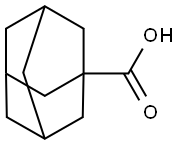
1-Adamantanecarboxylic acid is a white or off-white crystalline powder under ambient conditions, exhibiting notable acidity and good chemical stability. 1-Adamantancarboxylic acid is a basic raw material in the synthesis of many adamantane compounds which are with great practical importance in the fields of pharmaceutical, polymeric, paint and varnish, fuel and other chemical industries.

Figure1: Picture of 1-Adamantanecarboxylic acid
Coordinate to metal ions
In the assembly reactions of zinc(II) and copper(II) nitrates, researchers employed a ligand combination comprising 4-styrylpyridine (spy) and 1-adamantanecarboxylic acid (Hadc). Within the current research landscape concerning the synergistic construction of coordination compounds using 1-adamantanecarboxylic acid with N-donor auxiliary ligands, only one documented study [35] has reported copper(II) coordination polymers based on 1-adamantanecarboxylate. The aforementioned literature demonstrates the construction of a one-dimensional chain coordination polymer utilizing the endo-bidentate coordination mode of 1-adamantanecarboxylic acid in conjunction with three distinct N-donor coligands.
Separation and purification
This invention concerns a process for the separation and purification of an adamantanecarboxylic acid mixture, with a specific focus on isolating 2-adamantanecarboxylic acid and **1-adamantanecarboxylic acid**. Comprising essential stages of esterification and subsequent separation, the procedure is characterized by employing 98% sulfuric acid as the catalyst during the esterification step, where the catalyst-to-reactants ratio is maintained within a range of 0.5-3:10, the reaction duration is controlled between 15 to 140 minutes, and the operational temperature is kept within 55-70°C; thereafter, water and sodium hydroxide are introduced to elevate the solution's pH beyond 10, thereby facilitating the segregation of an aqueous phase and an ester layer. The fundamental principle of this invention hinges on an esterification reaction which exploits the differential esterification kinetics observed between 2-adamantanecarboxylic acid and **1-adamantanecarboxylic acid** to achieve their effective separation. Consequently, the devised methodology is not only straightforward and practical in application but also yields post-purification products, particularly the isolated **1-adamantanecarboxylic acid**, with satisfactory purity levels. Notably, the process allows for the comprehensive utilization of residual streams from adamantanecarboxylic acid manufacturing, leading to a substantial reduction in the discharge of "three wastes" and the prevention of associated environmental pollution, thereby rendering the invention economically viable and environmentally benign, with demonstrably significant economic and social benefits. [1]
Synthesis of 3-Hydroxy-1-adamantanecarboxylic acid
3-Hydroxy-1-adamantanecarboxylic acid was synthesized through the oxidation of 1-adamantanecarboxylic acid using nitric acid and concentrated sulfuric acid as oxidizing agents. Under optimized reaction conditions, the target compound was obtained in a maximum isolated yield of 77%. Comprehensive structural characterization of the product was performed employing Fourier-transform infrared spectroscopy (FT-IR), proton nuclear magnetic resonance spectroscopy (<sup>1</sup>H NMR), elemental analysis, and melting point determination. Based on the analytical data and precedent literature, a plausible reaction mechanism for the formation of 3-hydroxy-1-adamantanecarboxylic acid from the starting material 1-adamantanecarboxylic acid was proposed. [2]
Detection method
A patented methodology has been disclosed for the quantitative determination of 1-adamantanecarboxylic acid in soil and water matrices using gas chromatography. The analytical procedure comprises the following sequential steps: (1) preparation of standard working solutions; (2) preparation of sample solutions; and (3) instrumental analysis and quantitative calculation. The method utilizes a flame ionization detector (FID) with an HP-5 capillary column (30 m × 0.32 mm, 0.25 μm) for chromatographic separation, employing an external standard approach for quantification. Validation data demonstrate that the method achieves a detection limit (LOD) of 0.10 mg/L and a quantification limit (LOQ) of 0.22 mg/L for 1-adamantanecarboxylic acid. The calibration curve exhibits excellent linearity within the concentration range of 0.80-10.0 mg/L, represented by the linear equation y = 8.5952x + 4.8097 with a correlation coefficient (R²) of 0.9987. The precision of the method is confirmed by relative standard deviations of 0.01% for retention time (RSD_R.T.) and 4.97% for peak area (RSD_Area), both remaining below the 5.00% threshold. The mean spiked recovery rates for the target analyte reach 105.2% in soil and 101.5% in aqueous matrices, respectively. This developed methodology demonstrates outstanding characteristics including high specificity, excellent reproducibility, superior recovery rates, operational efficiency, remarkable sensitivity, and reliable accuracy.[3]
Reference
[1] Guo, L., Method for separation and purification of 2-adamantanecarboxylic acid and 1-adamantanecarboxylic acid,2011,Chinese Patent, Patent number:CN102190614A.
[2] Hua, Zhu, et al. Research on synthesis of 3-hydroxy-1-adamantanecarboxylic acid. 2014, Journal of Chemical Industry & Engineering.
[3 J. Mao, A method for detecting 1-adamantanecarboxylic acid content in soil and water by gas chromatography, Chinese Patent, Patent number:CN202211411501.
You may like
See also

Lastest Price from 1-Adamantanecarboxylic acid manufacturers

US $1.10/g2025-09-19
- CAS:
- 828-51-3
- Min. Order:
- 1g
- Purity:
- 99.9%
- Supply Ability:
- 100 Tons Min
US $5.00-0.50/KG2025-05-30
- CAS:
- 828-51-3
- Min. Order:
- 1KG
- Purity:
- 99% hplc
- Supply Ability:
- 500TONS