Resonance in Formamide
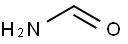
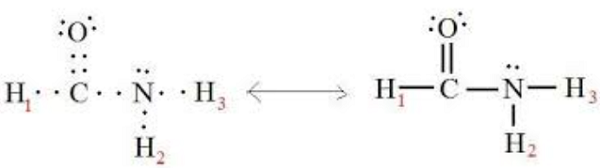
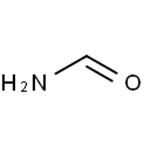
Amide structure and reactivity is conventionally interpreted within the framework of resonance theory. Formamide, the simplest amide, is poorly represented by the single Lewis structure I (X=O). Its planar geometry, large rotation barrier (18-19 kcal mol-1), and red-shifted carbonyl stretching frequency can be readily understood in terms of the strong resonance mixing of the dipolar form II. In contrast to typical pyramidal amine geometries, the planar amino group is stabilized by the resonance interaction of the p-type N lone pair with the carbonyl π system. The resulting CN double-bond character gives rise to the large rotation barrier, while the loss of CO double-bond character leads to a low CO stretching frequency.

In formamide, the sizable contribution of the dipolar form accounts for the planar amino geometry, large rotation barrier, and relatively short CN bond length. The weight of the dipolar form increases monotonically from formamide to telluroformamide in accord with the increasing rotation barrier and decreasing CN bond length. The larger polarizabilities of the heavier chalcogens allow these atoms to accommodate more charge density than anticipated on the basis of electronegativity.
Reference
[1] Glendening, E. D., & Hrabal, J. A. (1997). Resonance in Formamide and Its Chalcogen Replacement Analogues: A Natural Population Analysis/Natural Resonance Theory Viewpoint. Journal of the American Chemical Society, 119 52, 12940–12946. https://doi.org/10.1021/ja970074j
You may like
Related articles And Qustion
See also

Lastest Price from Formamide manufacturers

2026-03-02
- CAS:
- 75-12-7
- Min. Order:
- 1kg
- Purity:
- 99%
- Supply Ability:
- 99999
2025-09-10
- CAS:
- 75-12-7
- Min. Order:
- 1KG
- Purity:
- 99%
- Supply Ability:
- 20tons