Pyrazine: Aromatic Heterocycle
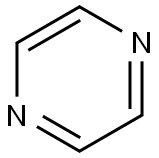
Pyrazine possesses a distinctive nutty, roasted aroma and is readily soluble in water, ethanol, diethyl ether, and other solvents. The molecule is a six-membered aromatic heterocycle with two nitrogen atoms in the para positions. It is chemically stable and readily undergoes substitution reactions such as alkylation and halogenation. It serves as an important intermediate for food flavorings and is widely used in the formulation of chocolate, coffee, grilled meat, and nut flavorings. It also functions as a fundamental building block for the synthesis of pharmaceuticals and pesticides.

Pharmacological activity and mechanism of pyrazines
Heterocycles are a common and important class of compounds in organic chemistry as they are often used in the synthesis of drugs and other materials. Many natural products are also composed of different kinds of heterocyclic structures. Pyrazine is a typical heterocycle whose structure is characterized by a nitrogen-containing six-membered ring. It has two nitrogen atoms, which are both H-bond acceptors. The topological polar surface area (TPSA) value is 25.78, indicating good membrane permeability. The consensus logP value is 0.25 which is lower than 3, and indicates good gastrointestinal (GI) absorption and aqueous solubility. It has been predicted that pyrazines will generally have difficulty permeating the blood brain barrier (BBB) as predicted by SwissADME online. It is not a P-glycoprotein (P-gp) substrate, or a hepatic microsomal enzymeinhibitor. Electrostatic potential analysis of pyrazine indicates that nucleophilic reaction takes place readily at any of its carbons. These physicochemical properties support its role as a valuable pharmacophore in drugs. The first strategy is modification at C1 and/or C2; strategy two is modification at C1 (and/or C2) and C3 (and/or C4); strategy three is use of pyrazine as a linker to connect two molecules, particularly natural products; strategy four is pyrazine fused into other heterocycles and strategy five covers complexes with metals in for example, organometallic drugs. These reported compounds showed different pharmacological activities such as antitumor, antibacterial, antiviral, antifungal, activity and AChE, BChE, MAO-B inhibitory activities.[1]
Pyrazine is a heterocycle common in drugs and natural products. In this review, we have described the structure, bioactivities and mechanism of action of the most active pyrazine derivatives based on their structure. We found that five modification strategies have been used, and among these, fusing pyrazine with other heterocycles is the most studied variant. The compounds that have been produced showed a wide spectrum of bioactivity including antitumor potency, which was the most studied, and antimicrobial, antiviral or other properties. Detailly, the antitumor activity of unilateral modification-derived compounds of pyrazine towards lung cancer (A549), human osteosarcoma (SAOS-2 and U2OS), breast cancer (MCF-7 and MDA-MB-231) were the most studied aspects. Their mechanism included downregulation of Bcl-2, c-Myc and G1 cyclins, surviving, myeloid cell leukemia sequence 1 (Mcl-1) NF-κB and upregulation of ROS, pro-apoptotic Noxa level. Other pathways, Akt/PI3K and Nrf2/HO-1 for example, were also related to anticancer action of these compounds.In conclusion, pyrazine derived compounds still are involved in a wide range of research prospects, especially as antitumor agents. It is worth being investigated as a non-stop endeavor. With the rapid development of combinatorial chemistry, rational drug design and chemical proteomics, we are confident that more novel pyrazine analogues with excellent bioactivity and wide applications will be discovered by researchers around the world.
Pyrazines from bacteria and ants
Leaf-cutter ants are major herbivores in the New World Tropics where they provide essential ecosystem services1. These ants collect fresh plant material to cultivate a symbiotic fungus, Leucoagaricus gongylophorous, that serves as their food source2. The scale at which these ants collect leaves makes them major agricultural pests in temperate regions of the New World3,4. Colonies of leaf-cutter ants in the genus Atta can have populations in the millions5 housed in subterranean nests that include an extensive network of tunnels and chambers which contain their fungal gardens. Pyrazines are heterocyclic natural products commonly used by ants to communicate. Mandibular glands secretions from Ponerini, Odontomachini and Ectatommini ants contain a mixture of 3-alkyl-2,5-dimethylpyrazines and 3-alkyl-2,6-dimethylpyrazines, compounds that mediate alarm behavior in Odontomachus workers. The bacterial associates of ants in the tribe Attine have recently been exploited as a promising source of antibiotics thought to protect their hosts. The production of volatiles – a critical class of molecules that guides ant behavior – by these bacteria, however, remain largely unknown.[2]
Ants use pheromones to coordinate their communal activity. Volatile pyrazines, for instance, mediate food resource gathering and alarm behaviors in different ant species. Here we report that leaf-cutter ant-associated bacteria produce a family of pyrazines that includes members previously identified as ant trail and alarm pheromones. We found that L-threonine induces the bacterial production of the trail pheromone pyrazines, which are common for the host leaf-cutter ants. Isotope feeding experiments revealed that L-threonine along with sodium acetate were the biosynthetic precursors of these natural products and a biosynthetic pathway was proposed.
References
[1]Hou, W., Dai, W., Huang, H., Liu, S.-L., Liu, J., Huang, L.-J., Huang, X.-H., Zeng, J.-L., Gan, Z.-W., Zhang, Z.-Y., & Lan, J.-X. (2023). Pharmacological activity and mechanism of pyrazines. European Journal of Medicinal Chemistry, 258, 115544. https://doi.org/10.1016/j.ejmech.2023.115544
[2]Silva-Junior, E.A., Ruzzini, A.C., Paludo, C.R. et al. Pyrazines from bacteria and ants: convergent chemistry within an ecological niche. Sci Rep 8, 2595 (2018). https://doi.org/10.1038/s41598-018-20953-6
See also


Lastest Price from Pyrazine manufacturers
$50.002025-04-21
- CAS:
- 290-37-9
- Min. Order:
- 1kg
- Purity:
- 99
- Supply Ability:
- 5000

2025-04-04
- CAS:
- 290-37-9
- Min. Order:
- 1kg
- Purity:
- 98%
- Supply Ability:
- 1Ton