Know(+)-Camptothecin
Introduction
In 1966, American chemists Monroe E. Wall and M. C. Wani isolated a light yellow needle-shaped crystalline alkaloid from the bark of a unique Chinese tree called Camptotheca acuminata, named (+)-Camptothecin (CPT) [1]. This discovery is not accidental - Camptotheca acuminata has long been recorded as being used to treat tumors in traditional Chinese medicine, and it was based on systematic screening of thousands of plants that the Wall team identified the significant activity of Camptotheca acuminata extract in the leukemia L1210 model [1][4].

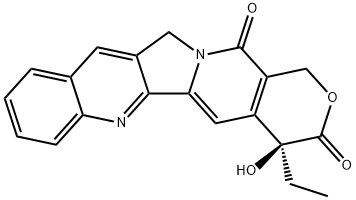
(+)-Camptothecin belongs to the quinoline alkaloids. Its core is a five-ring planar fused ring system, including quinoline (A and B rings), pyrrole (C ring), pyridone (D ring), and an α-hydroxy-δ-lactone (E ring) with a 20-position (S)-configuration chiral center [1][2]. This structure is unique among natural products, and it is also the starting point of its subsequent legendary story.
Mechanism of action
The anti-cancer mechanism of (+)-Camptothecin was only fully elucidated in 1985 - it does not directly inhibit enzyme activity, but acts as a "poison" for DNA topoisomerase I (TOP1) [2]. TOP1 is responsible for cutting and rejoining DNA single strands to release supercoil stress during DNA replication and transcription. (+)-Camptothecin covalently binds to the TOP1-DNA complex to form a stable ternary complex that prevents the re-ligation of broken DNA. When DNA replication forks encounter this complex, irreversible double-strand breaks are induced, ultimately initiating apoptosis [2].
X-ray crystallography revealed that the lactone ring (E ring) of (+)-Camptothecin is embedded between the +1 guanine base downstream of the nick and the side chain of Asn722, the 20-position hydroxyl group forms a hydrogen bond with Asp533, and the carbonyl group of the D ring interacts with the +1 cytosine [2]. These effects are strictly dependent on the (S) configuration of C‑20—the (R)‑enantiomer is completely inactive [1][4]. It is worth noting that the expression level of TOP1 in tumor cells is often higher than that in normal tissues, which provides a certain selectivity window for (+)-Camptothecin drugs [2].
Clinical application
(+)-Camptothecin’s clinical journey has been full of twists and turns. Due to its extremely poor water solubility, early clinical trials had to use the water-soluble sodium salt (open ring form of the lactone). Although it showed some efficacy against gastrointestinal cancer, severe bone marrow suppression, hemorrhagic cystitis, vomiting, and diarrhea led to the suspension of phase II trials in 1972 [2][4].
A change of fortune came in the late 1980s—the identification of the TOP1 target reignited research enthusiasm. Based on structure-activity relationship (SAR) studies, scientists introduced polar groups into the A/B ring and successfully developed two water-soluble derivatives: topotecan (Topotecan) and irinotecan (CPT-11), both of which were approved by the FDA in 1996 and 1994 respectively [2][3]. Topotecan is mainly used for ovarian cancer and small cell lung cancer, while irinotecan is the first-line drug for metastatic colorectal cancer. In addition, new generation derivatives such as Belotecan from South Korea and Exatecan and Lurtotecan in clinical research are expanding their scope of indications [3].
In recent years, antibody-drug conjugates (ADCs) and nanodelivery systems have become new directions. For example, ADCs conjugated with ixanotecan and trastuzumab have shown excellent targeted killing effects [2]; nanoliposome irinotecan (Onivyde®) was approved in pancreatic cancer, marking the entry of (+)-Camptothecin drugs into the era of precision delivery [3].
Synthesis method
The content of (+)-Camptothecin in plants is extremely low (only about 0.01% in dry bark), and Camptotheca acuminata is an endemic species in China, and wild resources face the risk of over-collection [2][4]. Therefore, full synthesis becomes the key to sustainable supply.
In 1971, Stork completed the first 15-step total synthesis [2]; in 1993, Danishefsky reduced it to 9 steps [2]. In 2001, the Comins team achieved a landmark 6-step asymmetric total synthesis with the following route[2][4]:
Starting from 2-methoxypyridine, DE ring fragments were constructed through three steps: directed lithiation, formylation, and reduction;
Control of C‑20 absolute configuration using the chiral auxiliary (‑)‑TCC;
The C ring was constructed through intramolecular Heck reaction ring closure, and finally optically pure (+)-Camptothecin (99% ee) was obtained in 64% yield.
This route is simple and scalable, laying a technological foundation for the subsequent synthesis of a large number of derivatives [2][4].
Detection method
The routine detection of (+)-Camptothecin and its derivatives mainly relies on reversed-phase high performance liquid chromatography (RP-HPLC), equipped with ultraviolet (UV) or fluorescence detectors, which can simultaneously quantify lactone and carboxylate forms [3]. For biological matrices such as plasma, HPLC‑MS/MS can provide higher sensitivity and selectivity to meet the needs of pharmacokinetic studies. In addition, stability indication methods need to examine the hydrolysis rate of the lactone ring at different pH and temperatures to evaluate the quality of the formulation [2][3].
Notes (warnings and challenges)
Although (+)-Camptothecin drugs have achieved great success, the following issues still need to be paid attention to in clinical application:
Hydrolysis of the lactone ring: The E ring is easily hydrolyzed under physiological pH to generate inactive carboxylates, which not only reduces the efficacy, but is also associated with certain toxic and side effects. Homocamptothecin (Homocamptothecin) expands the lactone into a seven-membered ring, which can significantly enhance stability [3].
Poor water solubility: Parent CPT is almost insoluble in water, which limits formulation options and is one of the main reasons for early failure [2].
Myelosuppression: It is the most common dose-limiting toxicity and requires close monitoring of blood routine [2].
Drug resistance: A variety of tumor cells have developed drug resistance, and the mechanisms involve overexpression of drug efflux pumps (such as ABC transporters), TOP1 gene mutations, or downregulation of protein expression [2][3].
Individual differences: The production of SN-38, the active metabolite of irinotecan, is affected by UGT1A1 gene polymorphisms, and some patients require dose adjustment [2].
Resource sustainability: Camptotheca acuminata is an endemic species in China, and the protection of wild populations cannot be ignored. Total synthesis and cell culture are alternative solutions [2][4].
Conclusion
(+)-Camptothecin’s story is far from over. In addition to anti-tumor, recent studies have also revealed its diverse activities such as anti-viral (HIV, HSV), anti-parasitic (Trypanosoma, Leishmania), insecticidal, and anti-psoriasis [3]. At the same time, ADC conjugates, nanoformulation and genetic polymorphism-guided personalized treatment are pushing (+)-Camptothecin to a new level of precision medicine [2][3]. As Martino et al. said: "We are not standing at the end of the (+)-Camptothecin story, but at the starting point of the '(+)-Camptothecin-like conjugates' story."[2]
References
[1] Wall ME, Wani MC, Cook CE, Palmer KH, McPhail AT, Sim GA. Plant antitumor agents. I. The isolation and structure of camptothecin, a novel alkaloidal leukemia and tumor inhibitor from Camptotheca acuminata. J Am Chem Soc. 1966;88(16):3888-3890. DOI: [10.1021/ja00968a057](https://doi.org/10.1021/ja00968a057)
[2] Martino E, Della Volpe S, Terribile E, et al. The long story of Camptothecin: From traditional medicine to drugs. Bioorg Med Chem Lett. 2017;27(4):701-707. DOI: [10.1016/j.bmcl.2016.12.085](https://doi.org/10.1016/j.bmcl.2016.12.085)
[3] Liu YQ, Li WQ, Morris-Natschke SL, et al. Camptothecin and its analogs: A comprehensive review of their biological activities. Med Res Rev. 2015;35(5):1-37. DOI: [10.1002/med.21342](https://doi.org/10.1002/med.21342)
[4] Wall ME, Wani MC. Camptothecin and taxol: From discovery to clinic. J Ethnopharmacol. 1996;51(1-3):239-254. DOI: [10.1016/0378-8741(95)00167-0](https://doi.org/10.1016/0378-8741(95)00167-0)
You may like
Related articles And Qustion


Lastest Price from (+)-Camptothecin manufacturers

$10.002025-08-22
- CAS:
- 7689-03-4
- Min. Order:
- 1ASSAYS
- Purity:
- 99%
- Supply Ability:
- 1 ton

2025-04-21
- CAS:
- 7689-03-4
- Min. Order:
- 1kg
- Purity:
- 0.99
- Supply Ability:
- 1000kg