Ethylparaben - Do you know about it?
Introduction
Ethylparaben is commonly known as ethyl p-hydroxybenzoate,It is a bactericidal preservative commonly used in food, cosmetics, and medicine. It mainly exerts a preservative effect by inhibiting microbial growth. Due to its low toxicity, high safety, and broad-spectrum antibacterial properties, this substance has been approved as a food additive by the Food and Agriculture Organization (FAO) and the World Health Organization (WHO), and it is also recognized as a safe preservative in the pharmaceutical and daily chemical industries.
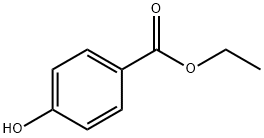
Ethyl p-hydroxybenzoate appears as a white crystalline powder at room temperature, odorless . Melting point is usually between 114 and 117℃. Its molecular formula is C9H10O3, Its structural formula is shown in Figure 1. The structural formula intuitively shows that ethyl parahydroxybenzoate contains a hydrophilic hydroxyl group (-OH), while also containing a relatively large hydrophobic benzene ring and ethyl group. Overall, its properties tend to be more nonpolar, so it is very slightly soluble in water but easily soluble in organic solvents such as ethanol (96%) and methanol.

Figure 1. Structural formula of ethylparaben
Application
Due to its excellent antibacterial activity, the application of ethylparaben almost covers all aspects of daily life. It is widely added to products such as soy sauce, vinegar, jam, pastry fillings, carbonated drinks, and fruit and vegetable preservation. In our country, it is stipulated that for use in pastry fillings, the maximum usage is 0.5 g/kg (calculated as p-hydroxybenzoic acid, the same below); in fruit juice (flavored) drinks, jams (excluding canned), soy sauce, and sauces, the maximum usage is 0.25 g/kg; in carbonated drinks and egg yolk fillings, the maximum usage is 0.2 g/kg; in vinegar, the maximum usage is 0.1 g/kg; and in fruit and vegetable preservation, the maximum usage is 0.012 g/kg [1], Prevent food from spoiling due to microbial growth during its shelf life,It is also commonly used as a preservative and antibacterial agent in liquid preparations such as syrups and oral solutions, as well as in semi-solid preparations like ointments. Solutions of low concentration (such as 0.1%) can even be used to treat fungal corneal ulcers[2].
Principle of preservation
The reason why ethyl paraben is commonly used as a preservative is that, from the molecular and cellular levels, this substance can induce mitochondrial dysfunction, leading to cellular ATP depletion[3]. Disrupt the mitochondrial membrane potential and uncouple the respiratory chain to inhibit cellular energy metabolism, leading to increased reactive oxygen species and cell apoptosis. and lead to an increase in reactive oxygen species and cell apoptosis[4], the normal mitochondrial respiratory electron transport chain is shown in Figure 2. It also has broad-spectrum antibacterial properties: it is highly effective at killing mold and yeast, with results better than sorbic acid and benzoic acid. However, its inhibitory effect on certain bacteria (especially Gram-negative bacilli) is slightly weaker. Moreover, its antibacterial effect is not greatly affected by pH value and is effective within the pH range of 4 to 8[5], so it has a relatively wide range of applications.

Figure 2. Mitochondrial respiratory electron transport chain
Detection methods
There are clear regulations on the dosage of preservatives in food, drugs, and skincare and cosmetic products, so the methods for detecting their content are very important. The detection methods include: spectroscopic methods that use the characteristic spectra of substances for qualitative and quantitative analysis; Thin-layer chromatography(TLC) for rapid detection of parabens content[6];Efficient and low-consumption[7] capillary electrophoresis(CE) ; Gas chromatography commonly used for detecting preservatives in cosmetics, soft drinks, soy sauce, and yogurt(GC); High-performance liquid chromatography, high-performance liquid chromatography-mass spectrometry, and other methods. Among them, the method using SPE and HPLC-MS provides a highly sensitive and accurate analytical approach for detecting ethyl paraben in complex samples such as food and cosmetics[8].
In summary, ethyl paraben, with its stable and efficient preservative properties, plays an indispensable role in modern industry. However, in daily use, it is still necessary to strictly adhere to the limit requirements of the relevant national standards, ensuring that while exerting its preservative effect, the safety of consumers is maximally protected.
References
[1] GB 2760-2024 / National Food Safety Standard - Uses of Food Additives[S]. Beijing: Standards Press of China,2024.
[2]Wu Bokun, Wang Gangsheng, Guo Wenyou, et al.. Comparative experimental study of antimycotic effect of nipagin a and other drugs on the common pathogenic fungi of cornea [J]. Journal of Hebei Medical University, 1990, (02).
[3]Nakagawa Y, Moldeus P. Mechanism of p-hydroxybenzoate ester-induced mitochondrial dysfunction and cytotoxicity in isolated rat hepatocytes.[J]. Biochemical Pharmacology,1998,55(11):1907-1914.
[4]Szelag, S., Zablocka, A., Trzeciak, K.,et al. Propylparaben-induced disruption of energy metabolism in human HepG2 cell line leads to increased synthesis of superoxide anions and apoptosis[J]. Toxicology in vitro: an international journal published in association with BIBRA,2016,3130-34. DOI:10.1016/j.tiv.2015.11.011.
[5] Yang Nan, Chen Hongyi. Study on the Antibacterial Effects of Three Food Preservatives[J]. Science and Technology of Food Industry, 2007, (01): 189-190.
[6]Thomassin M, Cavalli E,Guillaum Ye,et al. Comparison of quantitative high performance thin layer chromatography and the high performance liquid chromatography of parabens[J].Journal of Pharmaceutical and Biomedical Analysis,1997,15:831-838
[7]L.Labat, E.Kummer, P. Dallet, et al.Comparison of high-performance liquid chromatography and capillary zone electrophoresis for the determination of parabens in a cosmetic product [J]. Journal of Pharmaceutical and Biomedical Analysis,2000,23 (4):763-769.
[8] Wang Juan. Simultaneous Analysis of Preservatives in Food and Cosmetics by High Performance Liquid Chromatography-mass Spectrometry[D]. Sichuan: Chengdu University of Technology, 2008.
See also

Lastest Price from Ethylparaben manufacturers

$8.702026-01-12
- CAS:
- 120-47-8
- Min. Order:
- 10kg
- Purity:
- 99.5% min
- Supply Ability:
- 10000kg
$1.002025-04-21
- CAS:
- 120-47-8
- Min. Order:
- 1KG
- Purity:
- 99.0~100.5%,BP2018/USP40
- Supply Ability:
- 20Tons/month