Capsaicin: Sources, Benefits and Risks
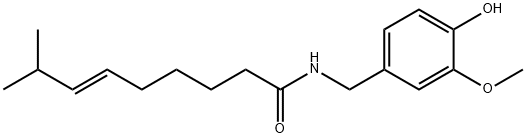
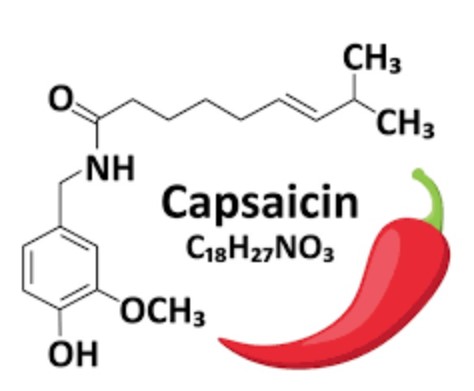
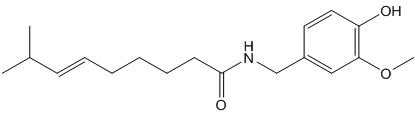
Capsaicin (trans-8-methyl-N-vanillyl-6-nonenamide) is the principal pungent component in hot peppers, including red chili peppers, jalapeños, and habaneros. Capsaicin is unique among naturally occurring irritant compounds because the initial neuronal excitation evoked is followed by a long-lasting refractory period, during which the previously excited neurons are no longer responsive to a broad range of stimuli. This process is referred to as desensitization and has been exploited for its therapeutic potential. However, their effectiveness in pain relief is also highly debated and some adverse side effects have been reported.

Sources
Natural
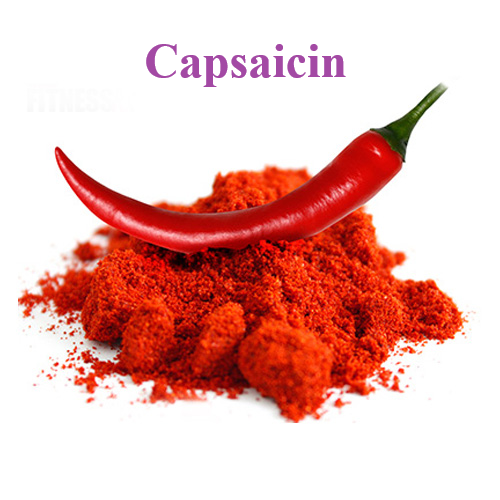
Capsaicin is a unique alkaloid found primarily in the fruit of the Capsicum genus and is what provides its spicy flavor. Capsaicin biosynthesis in plants is defined by two pathways: phenylpropanoid, which determines phenolic structure; and fatty acid metabolism, which determines the molecule’s fatty acids. Capsaicin concentration increases gradually during fruit development reaching maximum levels at 40 to 50 days, after which it tends to degrade into secondary compounds due to peroxidase action.[1]
Chemical
Capsaicin and its analogs are produced industrially using chlorinated fatty acids and amines at temperatures between 140 and 170 °C under moderate pressure. A number of studies have been done using chemical synthesis of capsaicinoids. Choi and Yoon used bioisosterism to synthesized 1-hydroxy-2-pyridone, a capsaicin analogue with similar biological effects. A study using chemoselective esterification of phenolic acids with alcohols for vanillyl nonanoate synthesis involved reactions between vanillyl alcohol and nonanoic acid using tetrahydrofurane as reaction medium and equimolar amounts of diisopropyl azodicarboxylate and triphenyl phosphine. Run at room temperature for 24 h, the reaction produced a 67% vanillyl nonanoate yield.[1]
Benefits
A large number of pharmacological studies have used capsaicin as a tool to activate many physiological systems, with an emphasis on pain research but also including functions such as the cardiovascular system, the respiratory system, and the urinary tract.
Understanding the actions of capsaicin led to the discovery its receptor, transient receptor potential (TRP) vanilloid subfamily member 1 (TRPV1), part of the superfamily of TRP receptors, sensing external events. This receptor is found on key fine sensory afferents, and so the use of capsaicin to selectively activate pain afferents has been exploited in animal studies, human psychophysics, and imaging studies.
In addition, capsaicin has been used as a therapeutic agent when applied topically, and antagonists of the TRPV1 receptor have been developed.[2]
Risks
The toxicity and safety of capsaicin and related compounds have been evaluated. A major, but predictable, conclusion was that capsaicin is a skin irritant even at low concentrations. Skin irritation and other tumor-promoting effects of capsaicin seem to be mediated mainly through interaction with the TRPV1, and the authors suggested that a potent tumor promoter might also be a moderate-to-severe skin irritant. Thus, a limitation on capsaicin content in topical applications that would significantly reduce its skin irritation potential might be expected to lessen concerns relating to tumor promotion potential.[3]
References
[1] Reyes-Escogido, M. D. L., Gonzalez-Mondragon, E. G., & Vazquez-Tzompantzi, E. (2011). Chemical and Pharmacological Aspects of Capsaicin. Molecules, 16(2), 1253-1270. https://doi.org/10.3390/molecules16021253
[2] O'Neill, J., Brock, C., Olesen, A. E., Andresen, T., Nilsson, M., & Dickenson, A. H. (2012). Unravelling the mystery of capsaicin: a tool to understand and treat pain. Pharmacological Reviews, 64 4, 939–971. https://doi.org/10.1124/pr.112.006163
[3] Bode, A. M., & Dong, Z. (2011). The two faces of capsaicin. Cancer Research, 71 8, 2809–2814. https://doi.org/10.1158/0008-5472.CAN-10-3756
You may like
Related articles And Qustion
See also


Lastest Price from Capsaicin manufacturers
2025-07-07
- CAS:
- 404-86-4
- Min. Order:
- 1kg
- Purity:
- 99%
- Supply Ability:
- 1000kg
$2.00-5.002025-05-08
- CAS:
- 404-86-4
- Min. Order:
- 1KG
- Purity:
- 99% hplc
- Supply Ability:
- 500TONS