Product Number: P109003
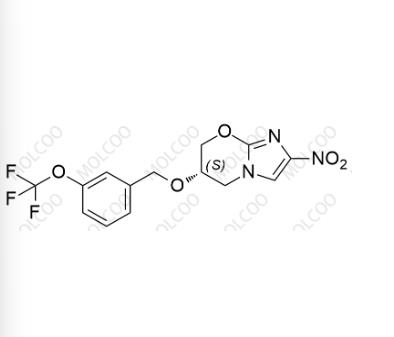
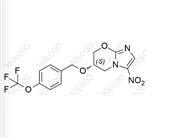
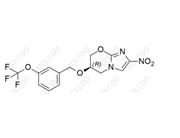
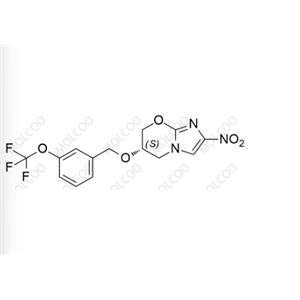
English Name: Pretomanid Impurity 3
English Alias: (S)-2-nitro-6-((3-(trifluoromethoxy)benzyl)oxy)-6,7-dihydro-5H-imidazo[2,1-b][1,3]oxazine
CAS Number: 1353753-57-7
Molecular Formula: C₁₄H₁₂F₃N₃O₅
Molecular Weight: 359.26
Product Advantages:
High purity and structural confirmation:HPLC purity ≥99.0%, confirmed by multiple methods including 1H NMR, 13C NMR, HRMS, and single-crystal X-ray diffraction, ensuring impurity structure accuracy and meeting ICH Q2(R1) standards.
Extreme condition stability:Stable for 36 months when stored at -20°C in the dark, with a degradation rate <0.5% after 10 days at room temperature in solution (e.g., dichloromethane), suitable for long-term storage and complex analytical scenarios.
Regioisomeric specificity:Clearly defined regioisomeric structure with a benzyloxy group at the 3-position of the benzene ring, enabling precise tracking of impurity risks caused by incorrect arylation reagent positioning in Pretomanid synthesis.
Applications:
Pharmaceutical impurity screening:Used for LC-MS/MS detection of Impurity 3 in Pretomanid APIs and formulations, controlling its content ≤0.1% in accordance with ICH Q3A standards to ensure global quality regulatory compliance.
Synthesis process optimization:In benzylation reactions, monitoring impurity content (e.g., reducing impurity from 1.1% to 0.1% when using para-substituted benzaldehyde derivatives) optimizes the substitution position and reaction conditions of arylation reagents to reduce regioisomeric by-products.
Analytical method validation:Serves as a regioisomeric impurity reference standard for developing specific detection methods, such as ultra-performance liquid chromatography-fluorescence detection (UPLC-FLD), leveraging benzene ring substituent differences to achieve efficient separation from the main peak.
Toxicological risk assessment:Provides standard samples for evaluating the potential toxicity of aryl positional isomer impurities, supporting in vitro cytotoxicity tests and in vivo pharmacokinetic studies to facilitate the establishment of safe exposure limits.
Background Description:
Pretomanid Impurity 3 is a regioisomeric impurity introduced during Pretomanid synthesis due to insufficient regioselectivity in benzylation reactions. The benzyloxy group at the 3-position of the benzene ring (instead of the 4-position in the parent drug) may alter the drug's lipophilicity and target binding ability, increasing off-target effect risks. According to the ICH M7(R1) guideline, such structurally similar impurities require toxicological evaluation, making their content control an important aspect of Pretomanid process development. Currently, the industry generally sets individual impurity limits at ≤0.1% with reference to ICH Q3B.
Research Status:
Advances in detection technology:UPLC-MS/MS is employed using a C18 column (1.8μm, 2.1×50mm) with 0.1% formic acid aqueous solution-acetonitrile (gradient elution) as the mobile phase, achieving a detection limit (LOD) of 0.005ppm in selected ion monitoring (SIM) mode for precise quantification of nanogram-level impurities.
Formation mechanism analysis:This impurity mainly originates from non-selective nucleophilic substitution of benzylation reagents (e.g., 3-(trifluoromethoxy)benzyl chloride). The proportion of regioisomeric products increases significantly under strongly basic conditions (e.g., NaH) or high temperatures (>60°C). Using weak bases (e.g., potassium carbonate) and low-temperature (25°C) reactions can reduce impurity formation by over 90%.
Safety evaluation:In vitro enzyme inhibition assays show that the impurity inhibits CYP450 3A4 enzyme activity twice as much as the parent drug, but rat acute toxicity tests (LD50 >2000mg/kg) indicate low toxicity. Combined risk assessment suggests a limit of ≤0.12%.




 China
China