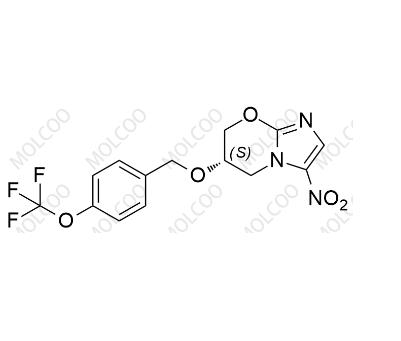
Product Number: P109002
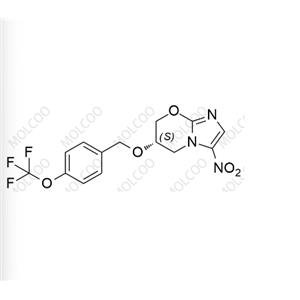
English Name: Pretomanid Impurity 2
English Alias: (S)-3-nitro-6-((4-(trifluoromethoxy)benzyl)oxy)-6,7-dihydro-5H-imidazo[2,1-b][1,3]oxazine
CAS Number: 1131004-99-3
Molecular Formula: C₁₄H₁₂F₃N₃O₅
Molecular Weight: 359.26
Product Advantages:
High-purity standard:HPLC purity ≥99.0%, with structure confirmed by multiple methods including 1H NMR, 13C NMR, HRMS (high-resolution mass spectrometry), and elemental analysis, meeting the strict requirements of FDA and EMA for impurity reference standards.
Reliable stability:Stable for 36 months when stored at -20°C in the dark, and with a degradation rate <1% after heating at 60°C for 48 hours in solution (e.g., acetonitrile-water system), suitable for long-term storage and high-temperature accelerated testing.
Precise chiral configuration:Defined (S)-configuration with optical purity ≥99.5% (determined by chiral HPLC), enabling accurate tracking of nitro positional isomerization impurity risks in Pretomanid synthesis.
Applications:
Pharmaceutical quality control:Used for LC-MS/MS detection of Impurity 2 in Pretomanid APIs and formulations, controlling its content ≤0.1% in accordance with ICH Q3B standards to ensure compliance with genotoxic impurity (GTIs) screening requirements.
Synthesis process optimization:In nitroimidazole cyclization reactions, monitoring impurity content (e.g., reducing impurity from 0.8% to 0.1% when reaction temperature decreases from 50°C to 30°C) optimizes nitration reagent dosage and reaction time to reduce by-product formation.
Analytical method development:Serves as a structural analog impurity reference standard for establishing specific detection methods, such as ultra-performance liquid chromatography-diode array detection (UPLC-DAD), to achieve baseline separation from the main peak (resolution >2.0).
Toxicological research support:Provides samples for evaluating the potential toxicity of nitro positional isomerization impurities, facilitating in vitro mammalian cell gene mutation tests (e.g., HPRT test) to meet regulatory requirements for impurity safety assessment.
Background Description:
Pretomanid Impurity 2 is a positional isomer impurity introduced during Pretomanid synthesis due to insufficient site selectivity in nitration reactions. The nitro group at the 3-position (instead of the 2-position in the parent drug) may affect the binding mode of the drug to Mycobacterium tuberculosis targets, increasing metabolic toxicity risks. According to the ICH M7(R1) guideline, impurities with nitroaromatic structures require genotoxicity assessment, making strict control of this impurity a key aspect of Pretomanid quality research. Current industry standards set the individual impurity limit at ≤0.1% with reference to ICH Q3A.
Research Status:
Innovations in detection technology:UPLC-MS/MS is used with a C18 column (1.7μm, 2.1×100mm) and 0.1% formic acid aqueous solution-acetonitrile (gradient elution) as the mobile phase. The limit of detection (LOD) can reach 0.01ppm under multiple reaction monitoring (MRM) mode, suitable for trace impurity quantification.
Formation mechanism research:This impurity mainly originates from the electrophilic substitution selectivity of nitration reagents (e.g., nitric acid-acetic anhydride system). The proportion of 3-nitro substitution products increases significantly under strongly acidic conditions (pH <2) or high temperatures (>40°C). Using weakly acidic nitration conditions (e.g., potassium nitrate-trifluoroacetic acid) and low-temperature (0-5°C) reactions can reduce impurity formation by over 85%.
Safety evaluation progress:In vitro Ames tests showed no mutagenicity at concentrations ≤200μg/dish, but renal tubular epithelial cell vacuolization was observed in high-dose groups (100mg/kg) during a 28-day repeated dosing test in rats, suggesting that reasonable limits (e.g., ≤0.08%) should be set based on toxicological data.




 China
China