Product Number: P109005
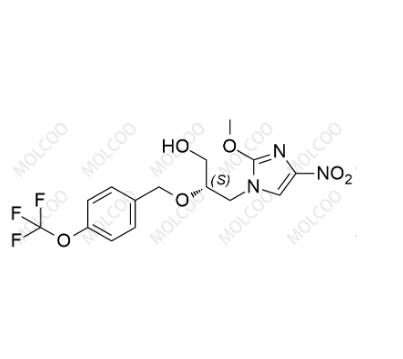
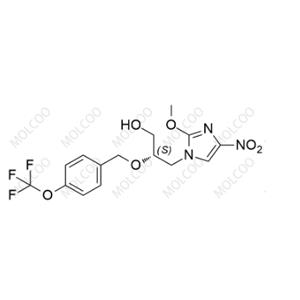
English Name: Pretomanid Impurity 5
English Alias: (S)-3-(2-methoxy-4-nitro-1H-imidazol-1-yl)-2-((4-(trifluoromethoxy)benzyl)oxy)propan-1-ol
CAS Number: 2512206-85-6
Molecular Formula: C₁₅H₁₆F₃N₃O₆
Molecular Weight: 391.30
Product Advantages:
High-purity standard:HPLC purity ≥99.0%, with structure confirmed by multiple methods including 1H NMR, 13C NMR, HRMS, and infrared spectroscopy, meeting the strict quality requirements of FDA and EMA for impurity reference standards.
Excellent stability:Stable for 36 months when stored at -20°C in the dark, with a degradation rate <1% after 7 days at 40°C in solution (e.g., acetonitrile-water system), suitable for long-term storage and accelerated stability testing.
Clear characteristic structure:As an impurity with nitro-substituted imidazole ring positional isomerism and uncyclized hydroxyl group, it accurately tracks process risks of incomplete imidazole ring construction and delayed cyclization in Pretomanid synthesis.
Applications:
Drug quality research:Used for LC-MS/MS detection of Impurity 5 in Pretomanid APIs and formulations, controlling its content ≤0.1% in accordance with ICH Q3B standards to ensure the reliability of synthesis processes and impurity safety.
Synthesis process optimization:In imidazole cyclization reactions, monitoring impurity content (e.g., reducing impurity from 1.0% to 0.1% when reaction time is extended from 2 hours to 4 hours) optimizes cyclization conditions to promote hydroxyl ring closure and reduce open-ring impurity formation.
Analytical method development:Serves as an open-ring structure impurity reference standard for establishing specific detection methods, such as ultra-performance liquid chromatography-tandem mass spectrometry (UPLC-MS/MS), achieving precise quantification of this impurity based on mass-to-charge ratio differences (limit of quantitation LOQ=0.05μg/mL).
Toxicological risk assessment:Provides samples for evaluating the potential toxicity of open-ring impurities, supporting in vitro genotoxicity tests (e.g., comet assay) and in vivo hepatotoxicity studies to meet regulatory requirements for in-depth impurity safety assessment.
Background Description:
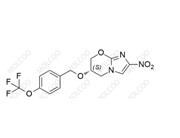
Pretomanid Impurity 5 is an open-ring impurity introduced during Pretomanid synthesis due to incomplete imidazole cyclization or unparticipated hydroxyl ring closure. Its structure retains a free hydroxyl group and a nitro group at the 4-position of the imidazole ring (instead of the 2-position in the parent drug), which may affect the drug's lipophilicity, metabolic pathways, and target binding ability, increasing off-target toxicity risks. According to the ICH M7(R1) guideline, such impurities with significant structural differences require comprehensive toxicological evaluation. Current industry standards set the individual impurity limit at ≤0.1% with reference to ICH Q3A.
Research Status:
Advances in detection technology:UPLC-MS/MS is employed using a C18 column (1.7μm, 2.1×100mm) with 0.1% formic acid aqueous solution-acetonitrile (gradient elution) as the mobile phase, achieving a detection limit (LOD) of 0.01ppm under multiple reaction monitoring (MRM) mode, suitable for quantitative analysis of trace open-ring impurities.
Formation mechanism research:This impurity mainly originates from insufficient hydroxyl nucleophilicity in imidazole cyclization reactions. Impurity accumulation occurs when water content in the reaction system exceeds 5% or catalyst (e.g., triethylamine) dosage is insufficient. Using dehydrated solvents (e.g., anhydrous DMF) and increasing catalyst dosage (1.5equiv) can reduce impurity formation by over 80%.
Safety evaluation:In vitro Ames tests showed no mutagenicity at concentrations ≤500μg/dish, but mild renal tubular damage was observed in high-dose groups (150mg/kg) during a 28-day repeated dosing test in rats, suggesting that reasonable limits (e.g., ≤0.08%) should be set based on toxicological data to ensure drug safety.




 China
China