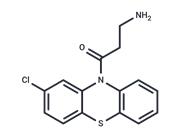
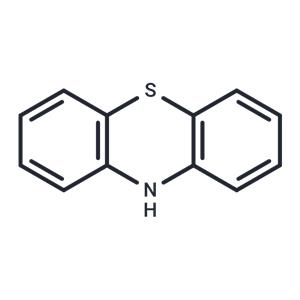
| Name | Phenothiazine |
| Description | Phenothiazine (ENT 38) is a class of agents exhibiting antiemetic, antipsychotic, antihistaminic, and anticholinergic activities. Phenothiazines antagonize the dopamine D2-receptor in the chemoreceptor trigger zone (CTZ) of the brain, potentially preventing chemotherapy-induced emesis. |
| In vitro | Phenothiazines mostly substitutes at position 10 with the dialkylaminoalkyl groups and additionally at position 2 with small groups exhibit valuable activities such as neuroleptic, antiemetic, antihistaminic, antipuritic, analgesic and antihelmintic. 2-trifluoromethyl-10-(4-aminobutyl)phenothiazine inhibits S. cerevisiae strains and T. mentagrophites with MIC of 0.4 μg/mL and 1.5 μg/mL, respectively. 10-carbamoylalkylphenothiazines shows significant activities against Gram-positive Bacillus subtilis with MIC's in the range of 7.8 μg/mL–30 μg/mL. The tetracyclic phenothiazines (modified with the naphthoquinone ring) shows significant actibacterial activity against S. aureus with the MIC50 of 12.5 μg/mL. Phenothiazines with the butylene linker are more effective than with the propylene linker, the 2-chloro-10-chloroethylureidobutyl derivative giving GI50 of 1.4 μM and 1.6 μM against 4 leukemia cell lines and 7 colon cancer cell lines. 10-Amino(hydroxy)propylphenothiazines (5 μM) induces a marked G2/M phase of cell-cycle arrest followed by cell death in human transformed WI38VA cells after 2-day incubation. [1] Phenothiazine drugs undergo extensive metabolism in the body before being excreted, mainly ring hydroxylation, ring sulphoxidation, N-demethylation, N-oxidation, sulphate and glucuronide conjugation. Phenothiazines have considerably lower binding affinities to α2-adrenoceptors than to dopamine D2 receptors and al-adrenoceptors. [2] Phenothiazines have significant in vitro activity against susceptible, polydrug- and multidrug-resistant strains of M. tuberculosis, as well as enhancing the activity of some agents employed for first-line treatment. [3] |
| Storage | Powder: -20°C for 3 years | In solvent: -80°C for 1 year
Shipping with blue ice/Shipping at ambient temperature. |
| Solubility Information | DMSO : 247.5 mg/mL (1242.03 mM), Sonication is recommended.
10% DMSO+40% PEG300+5% Tween 80+45% Saline : 2 mg/mL (10.04 mM), Sonication is recommended.
Ethanol : < 1 mg/mL (insoluble or slightly soluble)
H2O : < 1 mg/mL (insoluble or slightly soluble)
|
| Keywords | Phenothiazine | neurological | insecticidal | Inhibitor | inhibit | fungicidal | Fungal | ENT-38 | ENT38 | DopamineReceptor | Dopamine Receptor | Dopamine | Bacterial | Antibiotic | antibacterial | anthelmintic |
| Inhibitors Related | Neomycin sulfate | Calcium Propionate | D(+)-Raffinose pentahydrate | Sulfamethoxazole sodium | Terbinafine hydrochloride | Hydroxychloroquine | 2-Amino-2-methyl-1-propanol | Fenpyroximate | Hyaluronic acid sodium (MW 20 kDa) | Dimethyl sulfoxide | Sodium diacetate | Sodium bicarbonate |
| Related Compound Libraries | Anti-Parasitic Compound Library | Anti-Neurodegenerative Disease Compound Library | Neuronal Signaling Compound Library | Membrane Protein-targeted Compound Library | Drug-induced Liver Injury (DILI) Compound Library | Anti-Parkinson's Disease Compound Library | Anti-Fungal Compound Library | Neurotransmitter Receptor Compound Library | CNS-Penetrant Compound Library | Anti-Bacterial Compound Library | Endocrinology-Hormone Compound Library | GPCR Compound Library |


 United States