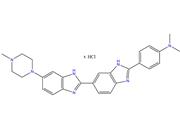
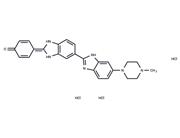
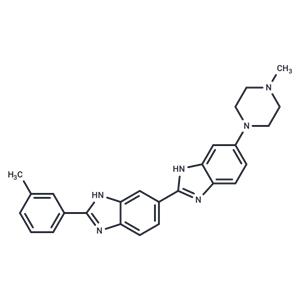
| Name | Hoechst 33258 analog 2 |
| Description | Hoechst 33258 analog 2 is part of a family of blue fluorescent dyes used to stain DNA. |
| Cell Research | I. Solution preparation
1. Stock solution preparation: Dissolve Hoechst 33258 analog 2 in DMSO or water to prepare a storage solution with a concentration of 1-10 mM.
2. Working solution preparation: Dilute to the appropriate concentration with PBS/DMEM/H2O before use. The common working concentration is 1-10 μM, but the specific concentration should be optimized according to experimental requirements.
II. Cell staining
1. Cell culture: Culture cells in appropriate culture dishes to ensure that the cells reach an appropriate density (e.g., 70%-80% confluence).
2. Staining: Add the working concentration of Hoechst 33258 analog 2 to the cell culture medium. The common working concentration is 1-10 µM, but the specific concentration can be adjusted according to experimental needs.
3. Incubate cells at room temperature or 37°C for 10-30 minutes. The specific time can be adjusted according to experimental requirements.
4. Wash cells: After staining, wash cells with PBS (phosphate buffered saline) to remove unbound dye and prevent nonspecific staining.
5. Fluorescence detection: Hoechst 33258 analog 2 emits blue fluorescence under UV light (360 nm) excitation, with an emission wavelength of 460 nm. The dye binds specifically to DNA, and its fluorescence can be detected by a fluorescence microscope or flow cytometer equipped with appropriate filters.
Notes:
1. Photosensitivity: Hoechst dye is light-sensitive, and long-term exposure to strong light may affect its fluorescence intensity. Therefore, it is recommended to handle in a low-light environment and avoid unnecessary light exposure during storage and operation.
3. Cytotoxicity: At high concentrations, Hoechst dye may be cytotoxic to cells. Therefore, the concentration needs to be optimized to reduce possible cell damage. |
| In vitro | The dyes Hoechst 33258 and Hoechst 33342 are the ones most commonly used and they have similar excitation/emission spectra. Both dyes are excited by ultraviolet light at around 350 nm, and both emit blue/cyan fluorescent light around an emission maximum at 461 nm. Unbound dye has its maximum fluorescence emission in the 510-540 nm range. Hoechst dyes are soluble in water and in organic solvents such as dimethylformamide or dimethyl sulfoxide. Concentrations can be achieved of up to 10 mg/mL. Aqueous solutions are stable at 2-6 °C for at least six months when protected from light. For long-term storage, the solutions are instead frozen at ≤-20 °C. Although the dyes can bind to all nucleic acids, AT-rich double-stranded DNA strands enhance fluorescence considerably. Hoechst dyes are cell-permeable and can bind to DNA in live or fixed cells. |
| Storage | keep away from direct sunlight | Powder: -20°C for 3 years | In solvent: -80°C for 1 year | Shipping with blue ice/Shipping at ambient temperature. |
| Solubility Information | H2O : < 0.1 mg/mL (insoluble)
DMSO : 60 mg/mL (142.01 mM), Sonication is recommended.
|
| Keywords | Inhibitor | inhibit | Hoechst 33258 analog 2 |
| Related Compound Libraries | Bioactive Compound Library | Bioactive Compounds Library Max |


 United States