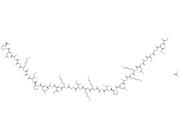
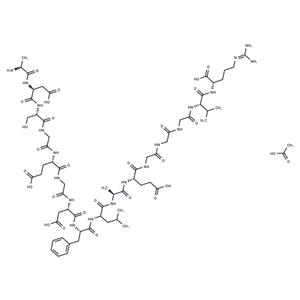
| Name | Fibrinopeptide A, human acetate |
| Description | Fibrinopeptide A, human acetate (Human fibrinopeptide A acetate) is a 16-residue short polypeptide cleaved from fibrinogen by thrombin. Fibrinopeptide A (FPA) is produced from the N-terminal Aα region of fibrinogen protein, on cleavage by thrombin. |
| In vitro | The conversion of monomeric fibrinogen into polymeric fibrin is mediated by thrombin, which binds to the central region of fibrinogen and catalyzes cleavage of the 2 short peptides, the 16-residue fibrinopeptide A (FpA) and the 14-residue fibrinopeptide B (FpB), located at the NH2-termini of the Aα and Bβ chains, respectively[1]. |
| In vivo | Fibrinopeptide A (FPA) is a small polypeptide cleaved from fibrinogen by thrombin, has a short half-life, and is considered a sensitive biochemical marker of thrombin activity, fibrin generation, and ongoing thrombosis[2]. |
| Storage | keep away from moisture | Powder: -20°C for 3 years | In solvent: -80°C for 1 year | Shipping with blue ice/Shipping at ambient temperature. |
| Solubility Information | DMSO : 5 mM, Sonication is recommended.
|
| Keywords | Human fibrinopeptide A Acetate | Fibrinopeptide A, human Acetate | Fibrinopeptide A, human acetate |
| Related Compound Libraries | Bioactive Compound Library | Peptide Compound Library | Bioactive Compounds Library Max |


 United States