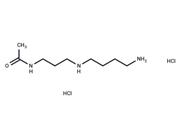
| Name | Acyclovir |
| Description | Acyclovir (Aciclovir) is a guanine analog and orally active antiviral agent characterized by a narrow antiviral spectrum, high selectivity, and low toxicity. Acyclovir exhibits activity against HSV-1 (IC50 = 0.85 μM), HSV-2 (IC50 = 0.86 μM), and varicella-zoster virus. Acyclovir can be used for herpesvirus treatment research. |
| Kinase Assay | Total AMPK activity is measured using the method of Dagher et al. AMPK activity is quantified in the resuspended pellet as incorporation of?32P from [γ-32P]ATP (10 GBq/mmol) into a synthetic peptide with the specific target sequence for AMPK, the SAMS peptide. Radioactivity is measured using a liquid scintillation counter. Protein content in the solution containing the resupended (NH4)2SO4 pellet is determined using the Bradford method. |
| In vitro | Methods: Flow cytometry was used to analyze the cell cycle distribution of Jurkat cells treated with 10 and 100 μM acyclovir at 24, 48, and 72 hours.
Results: Acyclovir induced S-phase arrest in Jurkat cells, and the sub-G1 apoptotic peak was significantly elevated at 72 hours. [4]
Methods: Cell viability of Jurkat, U937, and K562 leukemia cells treated with 3–100 μM acyclovir for 24, 48, and 72 hours was assessed using the trypan blue staining Methods.
Results: Acyclovir inhibited Jurkat cell viability in a dose- and time-dependent manner, while its inhibitory effect on U937 and K562 cells was weaker. [4] |
| In vivo | Methods: Female Danish Landrace pigs (n=6, weight 37–48 kg) received a single intravenous bolus injection of Acyclovir (10 mg/kg). Monitoring was conducted for 8 hours post-administration, with sampling every 30 minutes.
Results: Plasma drug concentrations peaked rapidly, but CNS distribution was slow and limited. [1]
Methods: Four healthy Asian elephant calves received a single intravenous bolus of Acyclovir (15 mg/kg). Blood samples were collected pre-dose and at 0, 0.25, 0.5, 0.75, 1, 1.5, 2, 3, 4, 5, 6, 12, 24, 36, and 48 h post-administration. Plasma drug concentrations were measured by LC-MS/MS.
Results: At 12 h post-administration, plasma concentrations remained above the IC50 for HSV-1/2 and EHV-1. [2]
Methods: Male Sprague-Dawley rats received epidural Acyclovir (0.3 mg, 0.6 mg, 0.9 mg) (dissolved in 100 μL) or intravenous Acyclovir (3 mg, 6 mg, 9 mg) (dissolved in 2 mL saline). Blood and cerebrospinal fluid (CSF) samples were collected 1 hour post-administration.
Results: CSF concentrations in the epidural group were significantly higher than those in the IV group (P<0.05), while plasma concentrations were significantly lower than those in the IV group (P<0.05).[3] |
| Storage | Powder: -20°C for 3 years | In solvent: -80°C for 1 year
Shipping with blue ice/Shipping at ambient temperature. |
| Solubility Information | 10% DMSO+40% PEG300+ 5% Tween 80 + 45% Saline : 4.29 mg/mL (19.05 mM), Solution.
10% DMSO+40% PEG300+5% Tween 80+45% Saline : 2.00 mg/mL (8.88 mM), Sonication is recommended.
DMSO : 42.92 mg/mL (190.58 mM), Sonication is recommended.
Ethanol : < 1 mg/mL (insoluble or slightly soluble)
10% DMSO+90% Saline : < 4.29 mg/mL (19.05 mM), Lower concentrations may be soluble, but exact solubility limit is unknown.
|
| Keywords | triphosphate | thymidine | RNASynthesis | RNA Synthesis | polymerase | kinase | Inhibitor | inhibit | immunosuppression | HSV | Herpes simplex virus | DNASynthesis | DNA synthesis | DNA | Bacterial | Apoptosis | anti-herpetic | antibody | Antibiotic | Acyclovir |
| Inhibitors Related | Neomycin sulfate | Aceglutamide | D(+)-Raffinose pentahydrate | Guanidine hydrochloride | Sulfamethoxazole sodium | Terbinafine hydrochloride | Formamide | Thymidine | Hyaluronic acid sodium (MW 20 kDa) | Dimethyl sulfoxide | Sodium diacetate | Sodium bicarbonate |
| Related Compound Libraries | Bioactive Compounds Library Max | Pediatric Drug Library | Anti-Cancer Clinical Compound Library | Bioactive Compound Library | Drug Repurposing Compound Library | Anti-Viral Compound Library | Anti-Cancer Approved Drug Library | FDA-Approved Drug Library | Immunology/Inflammation Compound Library | Anti-Aging Compound Library | Human Metabolite Library | Anti-Cancer Drug Library |



 United States