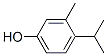
The o-cymen-5-ol (C10H14O) is a substituted phenolic compound derivative of isopropyl cresol. It was first synthesized in 1954 as an isomer of thymol, and it is colourless, odourless, and has a high stability and a favourable safety profile. To date, several studies have shown that its use combined with zinc chloride prevents the proliferation of pathogenic bacteria and, therefore, the appearance of the aforementioned oral pathologies, halitosis, gingival bleeding, plaque formation and dental erosion[1].
o-Cymen-5-ol is a broad-spectrum antimicrobial agent with direct antimicrobial activity. o-Cymen-5-ol showed effective minimum inhibitory concentrations (MICs) against a variety of bacteria and fungi, such as Streptococcus mutans and Candida albicans. The combination of o-Cymen-5-ol and zinc showed synergistic effects, enhancing the inhibitory effect against oral pathogens. o-Cymen-5-ol was able to inhibit the glycolysis process and co-enhanced this effect with zinc. o-Cymen-5-ol showed a stronger antibacterial effect in toothpaste than placebo[1].