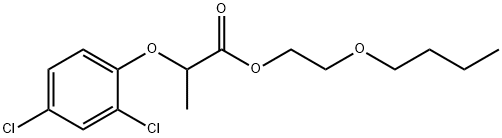
The industrial manufacture of dichlorprop butotyl follows the same pattern used for other phenoxy-propionate herbicide esters: first produce purified dichlorprop acid, then convert it into the desired ester under controlled conditions. Upstream, manufacturers generate dichlorprop acid by chlorinating and alkylating the phenoxypropionate framework, followed by resolution or controlled synthesis to achieve the required isomer ratio and then purifying the acid to technical grade. To form the butotyl ester, the acid is reacted with 2-butoxyethanol (or a similar butoxyalkanol) in an esterification step, typically using an acid catalyst and water-removal conditions to drive the reaction to completion while suppressing side reactions. After esterification, the mixture is neutralised, washed, and subjected to solvent removal and crystallisation or distillation to isolate technical grade dichlorprop-butotyl.
Selective, systemic, absorbed through leaves and translocates to roots. Synthetic auxin causing stem and leaf malformations leading to death.