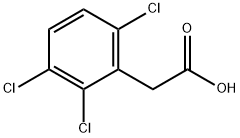
Chlorfenac is an obsolete herbicide for the control of annual weeds and grasses. It has a low aqueous solubility and is highly volatile. It may be persistent in both soil and water systems. It is moderately toxic to aquatic fife but has a low toxicity to birds. It is moderately toxic to mammals if ingested.
Chlorfenac is a herbicide used in agriculture for weed control mainly in sugar canes as well as other crops.
ChEBI: Chlorfenac is a member of the class of phenylacetic acids that is phenylacetic acid in which the phenyl group has been substituted by chlorines at positions 2, 3, and 6. An obsolete herbicide that was used as its sodium and ammonium salts. It has a role as a herbicide, an agrochemical and a synthetic auxin. It is a trichlorobenzene and a member of phenylacetic acids. It is a conjugate acid of a chlorfenac(1-).
Chlorfenac was commercially produced via a process that began with the preparation of 2-chloro-4-fluorophenol through selective chlorination of para-fluorophenol using chlorine gas or N-chlorosuccinimide in acetic acid, followed by deprotonation with sodium hydroxide to form the phenoxide salt. The key ether linkage was formed via nucleophilic substitution of ethyl chloroacetate with the phenoxide in ethanol at reflux, yielding the ethyl ester intermediate. Saponification with sodium hydroxide in aqueous methanol at 60–80°C, followed by acidification with hydrochloric acid, provided chlorfenac as the free acid.
Inhibits cell wall synthesis, Systemic, absorbed predominately by plant roots, with translocation. Auxin mimic.
Moderately toxic by ingestion andskin contact. When heated to decomposition it emits toxicfumes of Clí. An herbicide used for preemergence seasonlongcontrol of weeds.