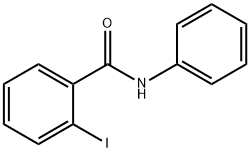
Benodanil is an obsolete fungicide. It has a moderate aqueous solubility, is volatile and, based on its chemical properties, is not expected to leach to groundwater. It is not persistent in soil systems. It is not highly toxic to mammals.
Benodanil is a fungicide used to protect crops and prevent certain plant diseases and ilnesses from spreading. May contribute to specific cytotoxic and genotoxic effects.
ChEBI: A member of the class of benzamides, obtained by formal condensation of the carboxy group of 2-iodobenzoic acid with the amino group of aniline. An obsolete fungicide once used mainly to control rust diseases.
Systemic, inhibits mitochondrial function by disrupting complex II (succinate dehydrogenase) in the respiratory electron transport chain.
Benodanil was prepared as follows: 43.2 grams (0.464 mole) of aniline and 46.9 grams of triethylamine were mixed in 930 ml of benzene and stirred. 123.7 g (0.464 mole) of 2-iodobenzoyl chloride in 450 ml of benzene was added to the first mixture through a dropping funnel. An exothermic reaction occurred. After addition, the mixture was refluxed for 1/2 hour. The mixture was cooled and the product was allowed to solidify. The product was filtered, added to water and stirred to dissolve triethylamine hydrochloride. The product was filtered again and dried to give 146.8 g of the desired product, Benodanil. (Yield 98%) m.p. 141-144C.