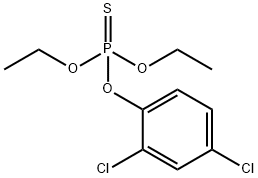
Dichlofenthion is an organophosphate insecticide. It was previously used to control nematodes and cutworms mainly on ornamental crops, lawns and turf. It has a low aqueous solubility, is quite volatile and mobile in soil. Dichlofenthion is moderately toxic to mammals, a skin, eye and respiratory tract irritant and a sensitiser. It is highly toxic to fish and aquatic invertebrates.
Colorless liquid. Boiling point 164-169°C (1.33×10⁻² kPa), relative density 1.320 (20/4°C). Easily soluble in most organic solvents and kerosene, with a solubility of 0.245 ppm in water.
ChEBI: Dichlofenthion is an organic thiophosphate.
Dichlofenthion is commercially synthesised through a multi-step process involving the formation of its phosphorothioate ester structure. The production typically begins with the reaction of 2,4-dichlorophenol with diethyl phosphorochloridothioate, forming the active compound. This reaction is carried out under controlled conditions using an organic solvent and a base to neutralise the hydrochloric acid byproduct.
Acetylcholinesterase (AchE) inhibitor
Poison by ingestion and
skin contact. A very toxic insecticide.
Mutation data reported. See also ESTERS
and PARATHION. When heated to
decomposition it emits very toxic fumes of
POx, SOx, and Cl-.