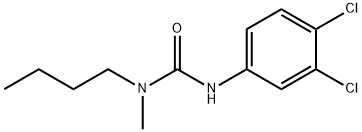
Crystalline solid; melts around 102 °C(215.6 °F); practically insoluble in water,48 mg/L at 24 °C (75.2 °F) (Merck 1996);slightly soluble in hydrocarbon solvents.
Preemergence control of grasses and broad-leaved weeds in peas, beans, lucerne,
garlic, beets, cereals, strawberries, ornamentals and forestry.
Neburon is synthesised through a streamlined one-step process involving palladium-on-carbon (Pd/C)-catalysed reductive carbonylation of nitroaromatic compounds. In this method, a nitro-substituted aromatic amine is reacted with carbon monoxide in the presence of a (Pd/C) catalyst and a suitable base under mild pressure and temperature conditions. This reaction directly forms the unsymmetrical urea linkage, which is central to neburon’s herbicidal activity.
ChEBI: Neburon is a member of ureas.
Acute oral toxicity is of very low order;moderately toxic by intravenous route.
LD50 oral (rat): 11,000 mg/kg
LD50 intravenous (mouse): 180 mg/kg.
Selective, absorbed through the roots. Inhibition of photosynthesis at photosystem II.
Soil. Neburon undergoes dealkylation of the terminal nitrogen atom, ring hydroxylation
and degradation to dichlorodihydroxyaniline (Hartley and Kidd, 1987). Residual activity
in soil is limited to approximately 3 to 4 months (Hartley and Kidd, 1987).
Chemical/Physical. Neburon hydrolyzes under basic conditions forming aniline derivatives.
The half-life of neburon in 0.50 N sodium hydroxide at 20°C is 167 days (El-Dib
and Aly, 1976).