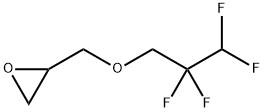
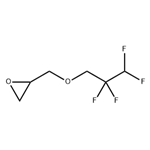
Glycidyl 2,2,3,3-tetrafluoropropyl ether is used as pharmaceutical intermediate.
In a vessel with a separator, a dropping funnel and a stirring device, 200 g (2.16 mol) of 1,2-epichlorohydrin (1,2-epichlorohydrin:tetrafluoropropanol is 4.8:1) and 60 mL of cyclohexane were added, and stirred and heated at 350 raps/min until the cyclohexane refluxed. Then, 65 g of 40% aqueous potassium hydroxide and 60 g (0.45 mol) of tetrafluoropropanol were added dropwise to the reaction system, and the water was removed while the reaction was going on, and the reaction was completed when the aqueous potassium hydroxide and the tetrafluoropropanol were finished, and the reaction ended when there was no water out of the reaction. After cooling, filtering to remove potassium chloride, the mother liquor was heated to 65 at atmospheric pressure to remove cyclohexane in the reaction solution, when cyclohexane was not distilled, the temperature was lowered to 30 , and then converted to reduced-pressure distillation, and pressure was adjusted so that the temperature of the distillation system was controlled at 65 , to recover the excess of 1,2-epichlorohydrin, and then, the fractions of 120-130 /250-300 Pa were collected, and the crude 3-(2,2,3,3) 3,3,3-tetrafluoropropoxy)-1,2-propene oxide was distilled under reduced pressure, and the fraction at 125-127 C/250-300 Pa was collected to obtain 70.5 g of 3-(2,2,3,3-tetrafluoropropoxy)-1,2-propene oxide, with a yield of 83.5% in terms of tetrafluoropropanol.