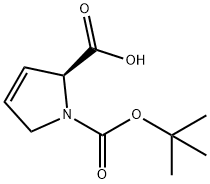
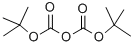
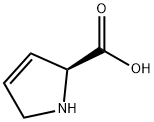
3,4-Dehydro-L-proline (1.0 g, 8.8 mmol) was used as starting material and dissolved in a mixed solution of water (9.0 mL) and sodium bicarbonate (2.23 g, 26.5 mmol). Dioxane (9.0 mL) and di-tert-butyl dicarbonate (3.86 g, 17.7 mmol) were then added. The reaction mixture was stirred at room temperature overnight, after which the solvent was removed by concentration under reduced pressure. The concentrated residue was partitioned between ether (20 mL) and water (25 mL) to separate the organic and aqueous layers. The aqueous layer was diluted with ethyl acetate (20 mL) and acidified by slow addition of concentrated hydrochloric acid while stirring vigorously to precipitate and extract the product (S)-1-(tert-butoxycarbonyl)-2,5-dihydro-1H-pyrrole-2-carboxylic acid into the organic layer. When the pH was reduced to about 2, the extraction was again carried out with ethyl acetate. The aqueous layer was treated with saturated sodium chloride solution and extracted a final time with ethyl acetate. All organic layers were combined, washed with saturated brine, dried over anhydrous magnesium sulfate, and concentrated under reduced pressure to give the target product (S)-1-(tert-butoxycarbonyl)-2,5-dihydro-1H-pyrrole-2-carboxylic acid (2.0 g, 100% yield) as a colorless viscous oil.

![(2S)-1-[(2-methylpropan-2-yl)oxycarbonyl]-2,5-dihydropyrrole-2-carboxylic acid pictures](/ProductImageEN/2021-09/Small/0783142c-228d-4fc7-afb5-6dc31835404f.png)