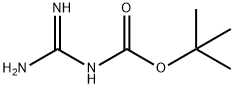
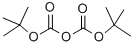
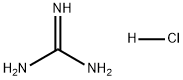
a) General procedure for the synthesis of BOC-guanidine: the method was carried out with reference to Ando et al. in Tetrahedron (2010, Vol. 66, No. 32, pp. 6224-6237). The procedure was as follows: 22.93 g (0.24 mol) of guanidine hydrochloride was dissolved in 50 ml of water at 0 °C, followed by the addition of 19.2 g (0.48 mol) of sodium hydroxide pellets. After stirring for 10 min, a clarified solution was obtained. Another solution was prepared by dissolving 13.1 g (60 mmol) of di-tert-butyl dicarbonate in 150 ml of acetone. The acetone solution of di-tert-butyl dicarbonate was added to the above aqueous solution of guanidine hydrochloride and sodium hydroxide in one go at 0 °C. After addition, the reaction mixture was transferred to room temperature and stirring was continued for 15 hours. After completion of the reaction, the acetone was removed under vacuum. The remaining aqueous phase mixture was extracted twice with 50 ml of ethyl acetate. The organic phases were combined, washed with 50 ml of saturated sodium chloride solution and dried with anhydrous sodium sulfate. After concentration under reduced pressure to remove the solvent, the resulting residue was recrystallized by ethyl acetate/n-heptane solvent mixture to give 8.7 g (91% yield) of BOC-guanidine as white crystals.EI-MS (M+): 159.
[1] European Journal of Organic Chemistry, 2008, # 2, p. 324 - 329
[2] Patent: US2015/361037, 2015, A1. Location in patent: Paragraph 0232; 0233
[3] Tetrahedron Letters, 2007, vol. 48, # 39, p. 6996 - 6999
[4] Organic and Biomolecular Chemistry, 2012, vol. 10, # 25, p. 4899 - 4906
[5] Chemical Communications, 2008, # 3, p. 344 - 346