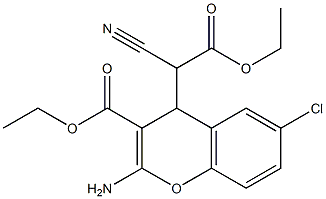
SC-79 is an activator of Akt that blocks its membrane translocation while allowing its phosphorylation, in the cytosol, by upstream kinases. For example, both Thr308 and Ser473 on Akt are phosphorylated in serum starved HeLa cells treated for 1 hour with insulin growth factor and SC-79 (4 μg/ml). SC-79 permits phosphorylation and activation of all isoforms of Akt, it is active in multiple cell types, and works in both receptor tyrosine kinase- and G protein-coupled receptor-mediated signaling. SC-79 has been used to elucidate the role of Akt signaling in neuronal survival, glucose-mediated apoptosis in podocytes, and miR-221-regulated cancer cell proliferation.
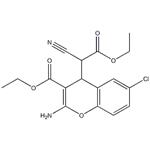
2-Amino-6-chloro-α-cyano-3-(ethoxycarbonyl)-4H-1-benzopyran-4-acetic Acid Ethyl Ester is a useful synthetic intermediate.
SC79 has been used in western blot analysis as a positive control to measure the extent of phosphorylation of Akt and also to activate Akt that has been suppressed by nitidine chloride, a natural bioactive alkaloid.
A cell-permeable and blood-brain barrier permeant bromo-to-chloro substituted HA14-1 (Cat. No.
371971) analog that renders Akt in a conformation susceptible to phosphorylation by upstream kinases via specific interaction with Akt pleckstrin homology (PH) domain PtdIns(3,4,5)P3- (PIP3) binding pocket. Shown to enhance both basal and receptor-mediated Akt phosphorylation (Thr308 and Ser473) in a time- and dose-dependent manner (2 to 4 μg/ml) with concomitant inhibition Akt membrane translocation in various cell cultures. Efficiently reduces glutamate-induced neurotoxicity both in primary neuron cultures (EC
50 = 4 μg/ml)
in vitro and in a murine MCAO (middle cerebral artery occlusion) model (40 mg/kg, i.p.)
in vivo.
In a 50mL round-bottomed flask, add 10mmol of 5-chlorosalicylaldehyde, 25mmol of ethyl cyanoacetate, 1mmol of anhydrous potassium carbonate, 20mL of water as a solvent, add a magnetic stirrer, and the reaction was stopped after a certain period of time with magnetic stirring in a constant temperature water bath. Leave to cool, pour off the upper layer of clear liquid, solid residue was added 15mL of ice-cold volume fraction 95% ethanol, stranded block solid, filtration, the solid was washed with a small amount of ice-cold volume fraction 95% ethanol for 2-3 times to obtain white crystals of ethyl 2-amino-6-chloro-Alpaha-cyano-3-(ethoxycarbonyl)-4H-1-benzopyran-4-acetate, air drying, weighing, calculating yield The product was characterized by determination of melting point, IR and HNMR. IR (KBr), v/cm-1: 3419.7, 3312.1, 2982.5, 2938.2, 2253.4, 1736.2, 1685.4, 1622.2, 1523.3, 1479.6, 1419.2, 1370.2, 1289.2, 1228.2, 1197.2, 1289.2, 1228.2, 1197.2, 1228.2, 1197.2, 1289.2. 1228.2, 1197.5, 1092.7, 1040.4, 826, 793.7.
sc79 was identified by a cell-based high-throughput chemical genetic screening, and inhibits akt membrane translocation. however, akt was paradoxically activated by sc79in the cytosol, specifically binding to the ph domain of akt. the conformation of sc79-bound akt is favorable for phosphorylation by upstream protein kinases. in a mouse model and a hippocampal neuronal culture system for ischemic stroke, the result of augmented neuronal survival is attained, based on the cytosolic activation of akt by sc79, which is sufficient to recapitulate the primary cellular function of akt signaling. thus, sc79, a unique specific akt activator, may be applied to enhance akt activity in various physiological and pathological conditions.
in aqueous environment, sc79 is relatively unstable. intriguingly, however, the sustained level of phosphorylated akt was observed both in cell culture and in vivo after the removal of sc79, indicating that sc79 may act irreversibly. the chemical moieties of sc79 (i.e., nitrile group) could be modified and/or reacts with amino acids. nevertheless, sc79, a relatively safe drug, was revealed by following fact. assignment of sc79 treatment much high dose (0.4 mg/g of body weight) did not accelerate any detectable changes in body weight (survival rate, appearance, and behavior) in mice. achievement of neuronal protective effect by i.p. injection suggests that sc79 also has a good penetration of blood–brain barrier. sc79 can be applied as a chemical platform to develop novel drugs for neurological and other complications
The small-molecule SC-79 activates cytosolic Akt and inhibits Akt translocation to the membrane. Binding of SC-79 to Akt promotes interaction between Akt and the protein kinase PDK1, leading to phosphorylation of Akt at Thr308 and Ser473. In a mouse model of acute liver failure, SC-79 treatment protects hepatocytes from apoptosis by inhibiting Akt-mediated aggregation of Fas and by blocking recruitment of FADD and procaspase-8 into the death-inducing signaling complex. Likewise, SC-79 protects hepatocytes from tumor necrosis factor-α-induced apoptosis and mice from induced liver injury and damage. In a rat model of alcohol-induced osteonecrosis, SC-79 exposure leads to activation of cytosolic Akt and attenuation of bone tissue morphological changes. SC-79 treatment of neuroblastoma cells and murine dopaminergic neurons leads to Akt activation and protection from hydrogen peroxide-induced apoptosis and necrosis.
[1] HAKRYUL JO. Small molecule-induced cytosolic activation of protein kinase Akt rescues ischemia-elicited neuronal death.[J]. Proceedings of the National Academy of Sciences of the United States of America, 2012, 109 26: 10581-10586. DOI:
10.1073/pnas.1202810109[2] WENZHUO YANG. MiR-221 Promotes Capan-2 Pancreatic Ductal Adenocarcinoma Cells Proliferation by Targeting PTEN-Akt.[J]. Cellular Physiology and Biochemistry, 2016, 38 6: 2366-2374. DOI:
10.1159/000445589[3] YI-XUAN CHEN. Novel Akt activator SC-79 is a potential treatment for alcohol-induced osteonecrosis of the femoral head.[J]. Oncotarget, 2017: 31065-31078. DOI:
10.18632/oncotarget.16075